

What Are Creatives in Social Media Marketing?
In the dynamic world of social media marketing, a “creative” refers to the visual and textual assets that make up a social media ad or organic post. Essentially, it’s the content a user sees and interacts with.
This is the art and science behind capturing attention, communicating a message, and driving a specific action, all within the fast-paced, scroll-heavy environments of platforms like Facebook, Instagram, TikTok, LinkedIn, and X (formerly Twitter).
Creatives are the cornerstone of any social media campaign. Without a compelling creative, even the most perfectly targeted ad or strategically planned post will fail to engage the audience.
Key Components of a Creative
A social media creative is a multi-layered asset, typically consisting of three main components that work together to deliver the message:
- The Visual Asset:
This is the most dominant element of the creative. It’s the image, video, carousel, or graphic that immediately catches the user’s eye as they scroll through their feed.- Images: High-quality, eye-catching photos or graphics.
- Videos: Short-form video has become the most effective format on platforms like TikTok and Reels. These can range from professionally produced clips to user-generated content (UGC) that feels more authentic.
- Carousels: A series of images or videos that users can swipe through, ideal for storytelling, product showcases, or step-by-step guides.
- Animations/GIFs: Visually engaging and can be used to add motion and personality.
- The Ad Copy (Text):
This is the written text that accompanies the visual. Its role is to hook the user, explain the value proposition, and drive them towards the call to action. Effective copy is concise, compelling, and tailored to the platform’s tone and the target audience’s language. It’s often structured with a captivating hook, a body that explains the offer, and a clear call to action. - The Call to Action (CTA):
The CTA is a direct instruction that tells the user what to do next. It’s the desired outcome of the creative. A strong CTA is clear, action-oriented, and creates a sense of urgency or benefit.- Examples: “Shop Now,” “Learn More,” “Sign Up,” “Download,” “Get a Quote,” or “Book Your Service Today.”

Why Creatives are So Important
In a competitive social media landscape, creatives are a brand’s opportunity to stand out. Here’s why they are so vital:
- Attention Grabbing: On average, users spend mere seconds scanning a post. A powerful visual is the hook that stops the scroll.
- Brand Storytelling: Creatives allow brands to convey their unique personality, values, and story visually and emotionally.
- Relevance: A great creative resonates with a specific audience, making the ad feel like a natural part of their feed rather than an interruption.
- Performance: The creative directly influences key performance metrics like Click-Through Rate (CTR) and Conversion Rate. A well-designed creative can drive down the Cost Per Click (CPC) and Cost Per Acquisition (CPA), making campaigns more profitable.
- Testing and Optimisation: Marketers constantly test different creatives (A/B Split Testing) to see which visuals, headlines, and CTAs perform best. This iterative process is crucial for optimising campaign performance.
In essence, while audience targeting and bidding strategies are the technical engines of a social media campaign, creatives are the fuel. They are the artistic and strategic output that connects a brand with its audience on an emotional level, transforming a simple ad into a memorable and effective marketing message.
From a small business in Murarrie creating short video clips for Instagram Reels to a global brand launching a polished video ad on YouTube, the quality of the creative is what separates a forgettable post from a highly successful campaign.
What is a Reel?
In the ever-changing world of social media marketing, the term “Reel” has become a true powerhouse, a content format that’s not just trending but fundamentally reshaping how brands connect with their audiences.
While you might associate them most readily with Instagram, their influence now spans across Facebook and TikTok (where they’re known as “TikToks” but serve a remarkably similar purpose). At its heart, a Reel is a bite-sized, vertically-oriented video, meticulously crafted for instant impact and designed to be devoured in quick bursts.
What Exactly is a Reel?
Think of a Reel as a mini-story, typically ranging from a few seconds up to 90 seconds. They’re often set to trending audio, catchy music, or authentic voiceovers, and what truly sets them apart is their dynamic, fast-paced editing and clever transitions.
Unlike static images or lengthy videos, a Reel is engineered to grab attention within the first fleeting moments, enticing viewers to watch again, share with friends, and jump into the conversation. It’s about delivering maximum punch in minimum time.
Why Are Reels a Game-Changer for Marketing?
From a marketing standpoint, Reels offer a treasure trove of opportunities, allowing businesses to hit a variety of objectives with remarkable efficiency:
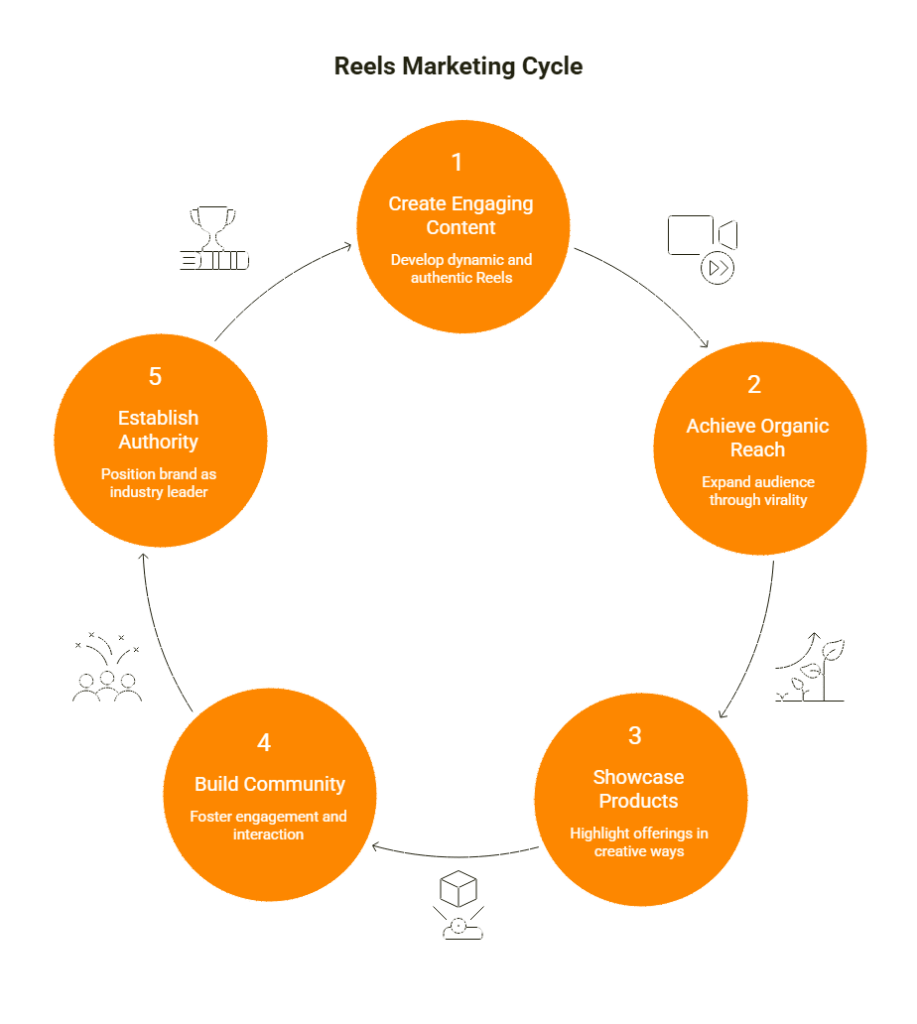
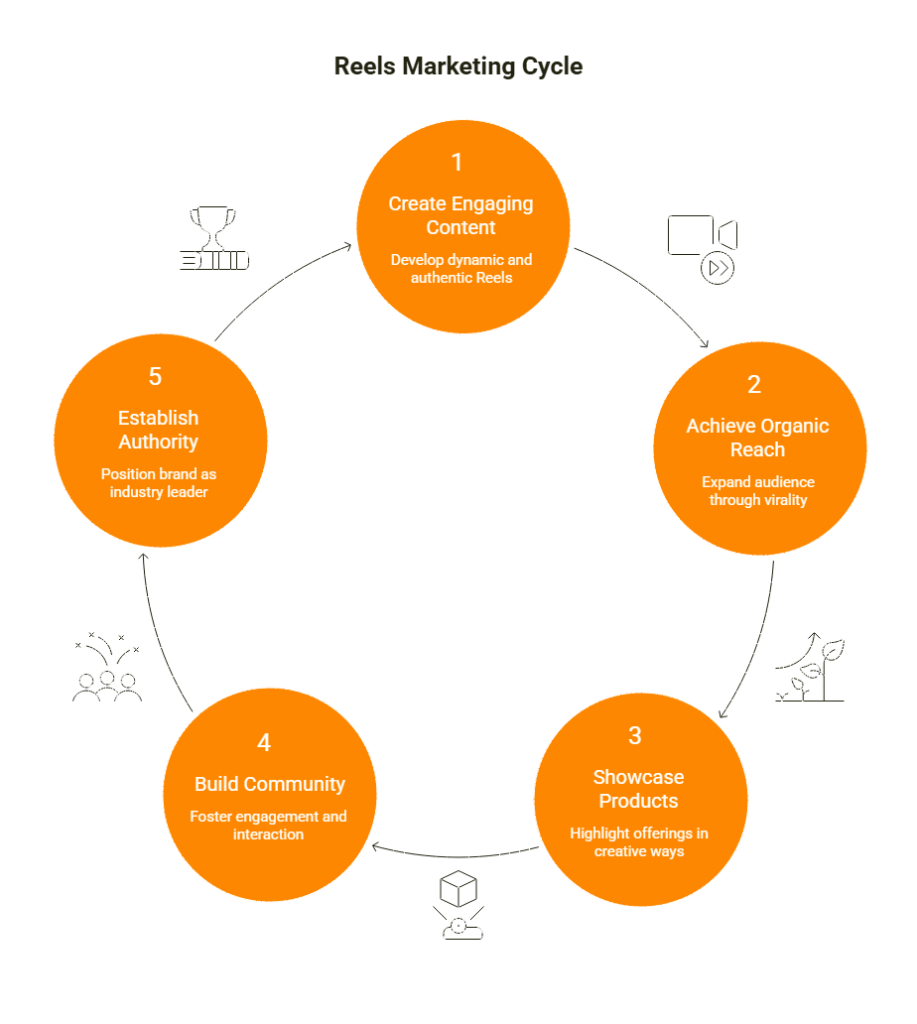
Unlocking Organic Reach and Virality: Perhaps the most compelling aspect of Reels is their inherent virality. The algorithms on platforms like Instagram actively favour and push Reels into users’ feeds and the coveted “Explore” page, even reaching those who don’t already follow your brand. This expanded organic reach is absolutely invaluable for boosting brand awareness, enabling businesses to tap into a far wider audience without necessarily pouring money into paid advertising. For smaller businesses and start-ups, this can be the ultimate accelerator for gaining visibility.
Showcasing Products and Services Dynamically: Forget dull, static product shots. Reels allow you to breathe life into your offerings, showcasing them in an authentic and engaging light. Imagine a fashion brand creating a quick Reel demonstrating five different ways to style a new dress, or a bakery sharing a rapid-fire recipe that highlights their signature ingredients. These mini-tutorials and behind-the-scenes glimpses help potential customers visualise themselves using your product, forging a stronger emotional connection and ultimately driving purchase decisions.
Building Community and Fostering Engagement: Reels are a fantastic tool for building a vibrant community around your brand. You can seamlessly integrate interactive elements like polls and Q&A stickers, and include clear calls to action that encourage viewers to comment, share, or even create their own content inspired by your brand. Jumping on trending audio and participating in popular challenges allows your brand to join broader cultural conversations, making you feel more relatable and approachable. This user-generated content is incredibly powerful for social proof and cultivating trust.
Establishing Authority and Thought Leadership: Beyond direct sales, Reels are brilliant for positioning your brand as a knowledgeable leader in your industry. You can create informative “how-to” videos, share quick tips, or even debunk common myths related to your niche. For example, a financial advisor could distil a complex investment concept into an easily digestible Reel, or a beauty brand could share a rapid-fire skincare routine. This adds genuine value to your followers’ feeds, reinforcing your credibility and solidifying your expertise.
The Bottom Line
In essence, a Reel in social media marketing isn’t just another video format; it’s a strategic weapon designed to capture fleeting attention and leverage powerful algorithms.
Its unparalleled ability to broaden your reach, present products in an exciting new light, cultivate a loyal community, and establish your brand as an industry expert makes it an absolutely indispensable tool in any modern marketing arsenal.
If your business is looking to truly cut through the digital noise and forge meaningful connections with your audience, mastering the art of the Reel isn’t just an option—it’s a fundamental necessity.
Are you ready to start creating your own engaging Reels?
What is a Story?
At the heart of social media marketing, the “Story” format has solidified its position as an indispensable tool. What began as an innovative feature on platforms like Snapchat rapidly gained immense popularity, becoming a core offering across giants such as Instagram, Facebook, and even professional networks like LinkedIn.
A Story represents a distinctive, ephemeral mode of communication, meticulously crafted for immediate consumption and to convey a genuine sense of being “in the moment.”
The Essence of a Social Media Story
At its core, a Social Media Story is a brief, vertically oriented, full-screen piece of content – typically a still image or a short video clip, often ranging from 15 to 60 seconds in duration, depending on the specific platform.
The defining characteristic that sets Stories apart is their transient nature: they typically disappear after a set period, most commonly 24 hours. This temporal limitation is crucial; it instills a compelling sense of urgency and exclusivity for the viewer, effectively encouraging them to engage with the content before it vanishes.
Unlike traditional feed posts, which are generally curated for greater longevity and polished presentation, Stories tend to be more spontaneous, raw, and less formal. This inherent authenticity fosters a more direct and personal connection with the audience, offering an unvarnished glimpse behind the brand’s usual façade.
Why Stories Resonate: The Power of the Ephemeral
The remarkable effectiveness of Stories in marketing stems from several psychological and behavioural factors unique to their design:
- Urgency and FOMO (Fear Of Missing Out): The 24-hour expiry date naturally creates a “now or never” mentality, prompting users to view content they might otherwise scroll past. This urgency is a powerful driver for immediate engagement and action.
- Authenticity and Relatability: The less polished, more spontaneous nature of Stories allows brands to showcase a human side, sharing unscripted moments, behind-the-scenes footage, or daily updates. This transparency builds trust and makes the brand feel more relatable and approachable.
- Dedicated Visibility: Stories typically appear prominently at the very top of a user’s social media feed, making them highly visible and easily accessible. This prime placement ensures consistent brand presence without competing with the more formal content in the main feed.
Strategic Marketing Applications
From a strategic marketing perspective, Stories offer a remarkably versatile toolkit, enabling brands to achieve a multitude of objectives:
- Building Genuine Connections: Use Stories to share candid moments, employee spotlights, or “day in the life” content. This humanises your brand, creating deeper, more authentic bonds with your audience.
- Driving Immediate Engagement & Action: Stories are inherently interactive, boasting features like polls, quizzes, Q&A boxes, countdowns, and crucial “swipe-up” links (for eligible accounts). These tools not only boost engagement metrics but also provide invaluable real-time feedback and direct pathways to websites or product pages, driving conversions.
- Enhancing Visibility & Brand Recall: Consistent Story posting ensures your brand remains present in your audience’s daily digital routine. This frequent, low-commitment exposure helps to reinforce brand recall and keeps your brand top-of-mind.
- Showcasing Dynamically & Creatively: Leverage Stories for quick product demonstrations, showing items in real-world use, or offering concise tutorials. A fashion brand might feature new arrivals via “try-on” hauls, while a food brand could share a rapid-fire recipe video. This dynamic presentation highlights product benefits vividly without feeling overly promotional.
- Amplifying Social Proof: Stories are ideal for integrating user-generated content (UGC), where you can easily reshare content from satisfied customers. They also serve as an excellent medium for influencer takeovers, allowing a fresh voice to directly engage with your audience, further building trust and credibility.
A Core Digital Strategy Component
Ultimately, a Story in social media marketing isn’t just another video format; it’s a strategic weapon designed to capture fleeting attention and leverage powerful algorithms. Its unparalleled ability to broaden your reach, present products in an exciting new light, cultivate a loyal community, and establish your brand as an industry expert makes it an absolutely indispensable tool in any modern marketing arsenal.
Ready to tell your brand’s story, one moment at a time? Contact Us Today!
Which is Better for Generating Leads & Sales - Posting vs Paid Ads?
When developing a plan for social media marketing, a frequent question arises: which method reigns supreme for generating leads and sales – organic posting or paid advertising? Both strategies offer distinct advantages and drawbacks, and understanding their individual strengths is crucial for maximising your return on investment (ROI).
The truth is, neither is inherently “better” in all scenarios; their effectiveness hinges on your specific business objectives, budget, target audience, and timeframe.
Organic Posting: Building Authentic Connections
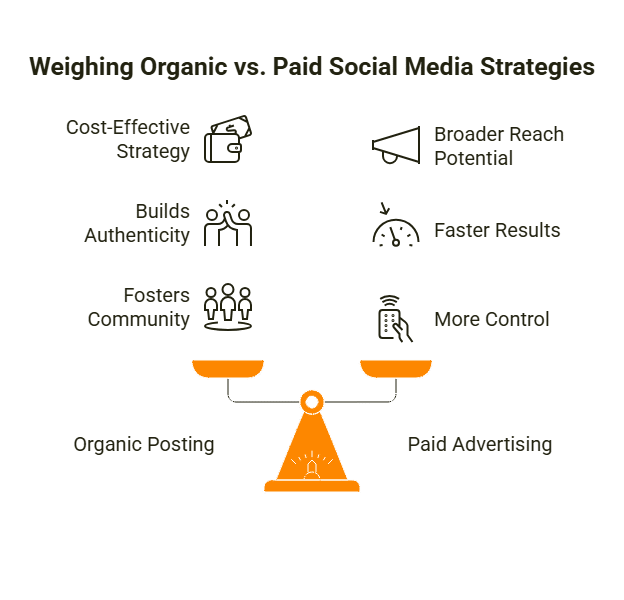
Organic posting refers to content shared directly on your brand’s social media profile without monetary promotion, encompassing updates, photos, videos, Reels, and Stories. Its primary strength lies in fostering authenticity and nurturing relationships.
- Cost-Effectiveness: Organic reach is “free” in terms of direct ad spend, making it highly attractive for startups and small businesses with limited marketing budgets.
- Trust and Credibility: Organically appearing content feels more genuine, fostering greater trust as your audience perceives value without an overt sales pitch.
- Community Building: Organic posting excels at nurturing a loyal community. Consistently sharing valuable content encourages conversations, builds advocates, and cultivates a sense of belonging, invaluable for repeat business and word-of-mouth referrals.
- Indirect SEO Benefits: Consistent, high-quality organic content can indirectly improve brand visibility, potentially leading to more brand mentions and improved search engine rankings.
However, a significant drawback is the substantial decline in organic reach across most major platforms. Algorithms increasingly prioritise paid content, meaning your organic posts may only reach a fraction of your followers. Consequently, generating substantial leads and sales purely through organic means can be a slow, labour-intensive process, demanding consistent high-quality content and ongoing interaction.
Paid Advertising: Precision, Scale, & Speed
Paid advertising involves investing money to promote your content, target specific audiences, and achieve defined marketing goals. This includes various ad formats across platforms like Meta Ads (Facebook/Instagram), LinkedIn Ads, or TikTok Ads.
- Targeting Precision: This is arguably the biggest advantage. Paid ads allow for granular targeting based on demographics, interests, behaviours, and custom audiences. This ensures your message reaches the most relevant potential customers, minimising wasted ad spend.
- Scalability: Once a successful ad campaign is identified, it can be scaled up rapidly by increasing your budget, allowing for swift increases in leads and sales. This makes paid ads ideal for rapid growth initiatives and short-term promotional pushes.
- Measurable ROI: Paid ad platforms offer extensive analytics, providing detailed data on impressions, clicks, conversions, and cost per lead. This enables continuous optimisation for better performance and clear justification of marketing expenditure.
- Speed and Immediate Reach: Paid ads cut through algorithmic noise, guaranteeing your content is seen by a larger, pre-defined audience almost instantly. This is critical for product launches, seasonal campaigns, or quickly filling a sales pipeline.
The primary drawback, of course, is the cost. Effective paid advertising demands a budget, and poorly optimised campaigns can quickly drain financial resources with minimal returns. There’s also the challenge of “ad fatigue,” where audiences can become desensitised to repeated messages, necessitating ongoing creative refreshes.
The Verdict: A Synergistic Approach
For most businesses, the “better” strategy isn’t an either/or dilemma but rather a synergistic combination of both.
Organic content lays the essential groundwork: building brand identity, fostering community, and establishing trust. Paid ads, conversely, provide the necessary boost for specific, measurable outcomes: driving targeted traffic, generating qualified leads, and accelerating sales.
A highly effective strategy involves using organic content to test messages and identify popular themes. Once compelling content is validated organically, it can then be strategically amplified with paid promotion to reach a broader, targeted audience for efficient lead generation and sales conversions. Conversely, insights from paid campaigns can inform and refine your organic content strategy, creating a powerful, data-driven feedback loop.
Ultimately, neglecting either your organic presence or strategic paid promotion means leaving significant opportunities untapped. A balanced approach, where both work in concert, is typically the most robust and rewarding path for generating sustainable leads and sales in today’s social media marketing landscape.

What is ROAS?
In the world of social media marketing, a key metric frequently discussed is ROAS, or Return on Ad Spend. This crucial indicator helps businesses quantify the effectiveness of their advertising efforts, revealing how much revenue is generated for every AUD invested in a specific ad campaign.
Far more than just a vanity metric, ROAS provides a direct measure of profitability for your advertising budget, guiding strategic decisions and optimising future campaigns.
ROAS Explained?
Simply put, ROAS is a ratio or percentage that illustrates the revenue earned from an advertising campaign relative to its cost. The calculation is straightforward:
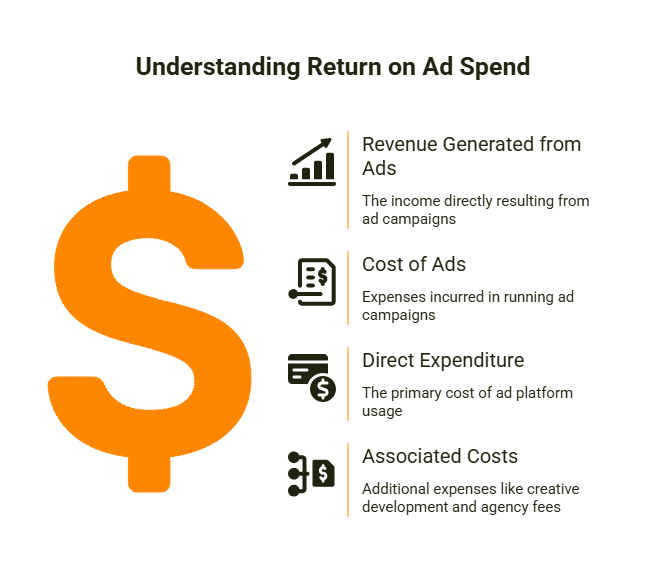
ROAS = (Revenue Generated from Ads / Cost of Ads) x 100%
For example, if a company spends AUD1,000 on a social media ad campaign and that campaign directly generates AUD4,000 in sales, the ROAS would be (AUD4,000 / AUD1,000) x 100% = 400%. This can also be expressed as a ratio, 4:1, meaning for every AUD1 spent on advertising, AUD4 in revenue was earned.
It’s important to clarify what constitutes “Cost of Ads.” While it primarily includes the direct expenditure on the ad platform itself, a more comprehensive ROAS calculation might also factor in other associated costs, such as creative development, agency fees, or even staff time dedicated to managing the campaigns. The choice of what to include depends on the level of granularity required for analysis.
Why is ROAS Crucial in Social Media Marketing?
ROAS is not just a calculation; it’s a vital compass for steering your social media advertising strategy. Its importance stems from several key benefits:
- Direct Profitability Insight: ROAS provides an immediate understanding of whether your ad spend is truly profitable. A ROAS above 100% (or 1:1 ratio) indicates that your ads are generating more revenue than they cost, though a higher figure is typically needed to cover other business expenses and achieve net profit.
- Optimisation and Resource Allocation: By tracking ROAS across different campaigns, ad sets, and even individual ad creatives, marketers can identify what’s working best. This allows for data-driven decisions on where to allocate more budget and where to pull back, ensuring resources are funnelled into the most effective channels and messages.
- Performance Benchmarking: ROAS allows businesses to set performance benchmarks and measure progress over time. While an “ideal” ROAS varies significantly by industry (e-commerce often aims for 4:1 or higher, while high-margin B2B might tolerate lower), having a target helps in evaluating success.
- Accountability and Reporting: For marketing teams, ROAS is a powerful metric for demonstrating the tangible impact of their efforts to stakeholders and senior management. It clearly articulates the financial return on advertising investment.
- Campaign Refinement: A low ROAS signals that a campaign needs adjustment. This could involve refining targeting, optimising ad copy and visuals, improving landing page experiences, or adjusting bidding strategies. ROAS acts as an early warning system for underperforming campaigns.
ROAS vs. ROI and Other Metrics
While similar, ROAS is distinct from Return on Investment (ROI). ROI takes a broader view, considering all costs associated with a business activity (including production, overheads, marketing, etc.) against the total profit generated. ROAS, conversely, focuses specifically on the revenue generated in direct relation to the advertising spend.
Both are crucial, but ROAS offers a more granular look at the efficiency of your ad campaigns themselves, making it particularly valuable for social media managers and performance marketers. Other metrics like Cost Per Acquisition (CPA) or Cost Per Lead (CPL) provide insights into customer acquisition costs but don’t directly quantify the revenue generated by those acquisitions.
ROAS is an indispensable metric in social media marketing, providing clear, actionable insights into the financial performance of your advertising efforts. By diligently tracking, analysing, and optimising for ROAS, businesses can ensure their ad budget is spent effectively, driving maximum revenue and contributing directly to overall business growth.
How Do We Measure Conversions?
When implementing social media marketing, simply generating likes or followers rarely suffices. For businesses, the true measure of success lies in conversions – the desired actions taken by a user that directly contribute to a business goal.

Measuring these conversions is paramount, providing tangible evidence of return on investment (ROI) and informing future strategic decisions. This process involves meticulous setup, robust tracking, and insightful analysis.
Defining Social Media Conversions
A conversion in social media marketing isn’t a one-size-fits-all concept; it’s defined by specific campaign objectives. Common examples include:
- Purchases: The ultimate goal for e-commerce, where a user completes a transaction.
- Lead Generation: Submitting a form (e.g., newsletter, whitepaper, demo request) or signing up for a free trial.
- App Installs: Users downloading and installing a mobile application.
- Downloads: Content downloads like e-books or brochures.
- Registrations: Signing up for a webinar, event, or account.
- Key Page Views: Visiting crucial pages such as “pricing” or “contact us,” indicating high intent.
The Mechanism of Measurement: Tracking
Effective conversion measurement relies on robust tracking systems. The primary tools and methods include:
- Conversion Pixels/Tags: These are small code snippets (e.g., Meta Pixel, LinkedIn Insight Tag) installed on a brand’s website. When a user takes a defined action, the pixel fires, sending data back to the social media platform. This attributes the conversion to the specific ad or organic content that drove it, aiding campaign optimisation.
- Google Analytics: A complementary tool providing comprehensive insights into website user behaviour. Integrating social media data (via UTM parameters) allows marketers to track traffic from social channels and monitor conversion paths, bounce rates, and engagement. Setting “Goals” in Google Analytics directly mirrors your defined conversions.
- UTM Parameters: Urchin Tracking Modules are simple text codes added to URLs. They enable precise tracking of the source, medium, and campaign for incoming traffic. For social media, UTMs are essential for differentiating between paid campaigns, organic posts, and influencer collaborations, ensuring accurate attribution within analytics tools.
- Platform-Specific Analytics: Each social media platform offers its own analytics dashboard (e.g., Facebook Ads Manager, LinkedIn Campaign Manager). These provide real-time data on ad performance, including conversion metrics reported directly by their pixels, invaluable for daily monitoring and optimisation.
- CRM Integration: For lead generation, integrating social media leads directly into a Customer Relationship Management (CRM) system allows for tracking leads through the sales pipeline. This provides visibility into which social efforts ultimately lead to qualified sales opportunities and closed deals, offering a true ROI picture.
Attribution Models
A critical aspect of measuring conversions is understanding attribution – how credit for a conversion is assigned when multiple touchpoints are involved. Common models include:
- Last Click: Full credit to the final touchpoint before conversion. Simple, but can overlook earlier influences.
- First Click: Full credit to the initial touchpoint. Good for understanding awareness drivers.
- Linear: Credit evenly distributed across all touchpoints.
- Time Decay: More credit given to touchpoints closer to the conversion.
- Data-Driven: Uses machine learning to assign credit based on actual account data, often considered most sophisticated.

Driving Business Growth
Measuring conversions in social media marketing moves beyond surface-level metrics to focus on tangible business outcomes. By meticulously setting up conversion pixels, leveraging analytics tools, utilising UTM parameters, and understanding attribution models, businesses gain invaluable insights into the effectiveness of their social media efforts, continuously optimising strategies to drive genuine business growth.
Selecting the right attribution model is crucial for accurately assessing the value of different social media activities and making informed budget decisions.
How Does Meta Know Who to Show Ads To?
Meta possesses an incredibly sophisticated advertising ecosystem, leveraging vast data and advanced algorithms to determine precisely who sees which ads. This isn’t magic, but a complex interplay of user behaviour, declared interests, and advertiser objectives, processed through powerful machine learning models. Understanding this is crucial for effective social media campaigns.
The Foundation: Data Collection
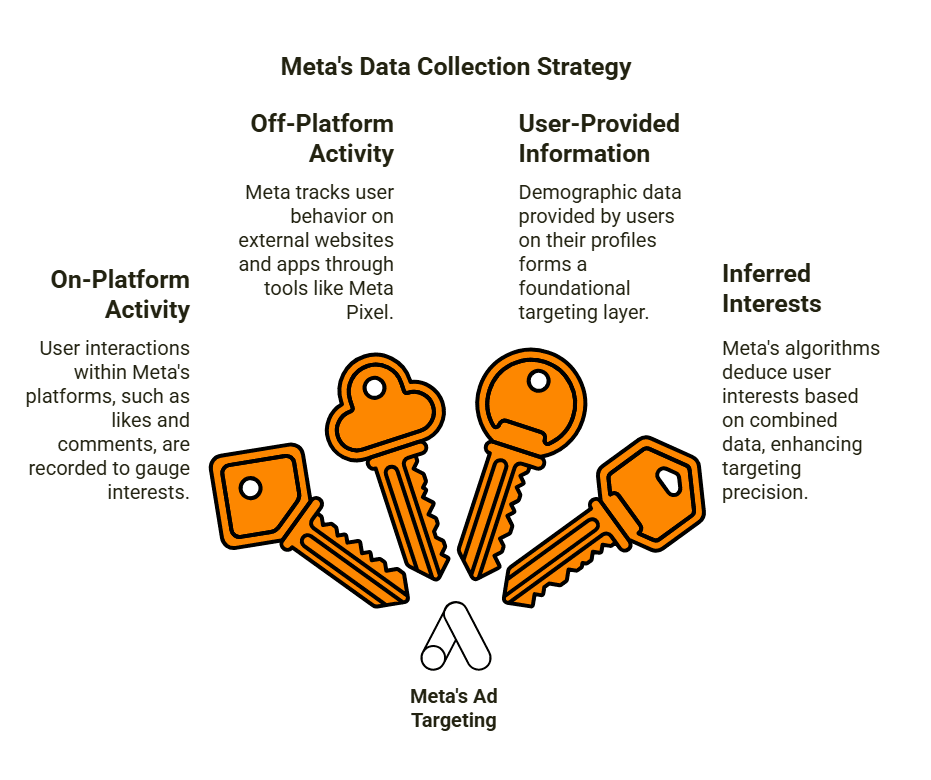
Meta’s ad targeting ability stems from extensive data collection across various sources:
- On-Platform Activity: Nearly every user interaction on Facebook, Instagram, Messenger, and other Meta properties is recorded. Likes, comments, video views, group joins, events attended, and even time spent viewing content all signal interest.
- Off-Platform Activity (Meta Pixel & Conversions API): When businesses use Meta’s tracking tools (Meta Pixel on websites, Conversions API for server-side data), Meta collects user behaviour outside its platforms. This includes website visits, product views, items added to cart, purchases, and app activity, providing crucial intent signals.
- User-Provided Information: Demographics like age, gender, location, relationship status, education, and job title are directly provided by users on their profiles, forming a foundational layer for targeting.
- Inferred Interests and Behaviours: Based on combined data, Meta’s algorithms infer broader interests. For example, frequent interaction with fitness pages and visits to sports equipment sites might categorise a user as “interested in fitness” or an “online shopper for sporting goods.”
The Meta Targeting Mechanisms
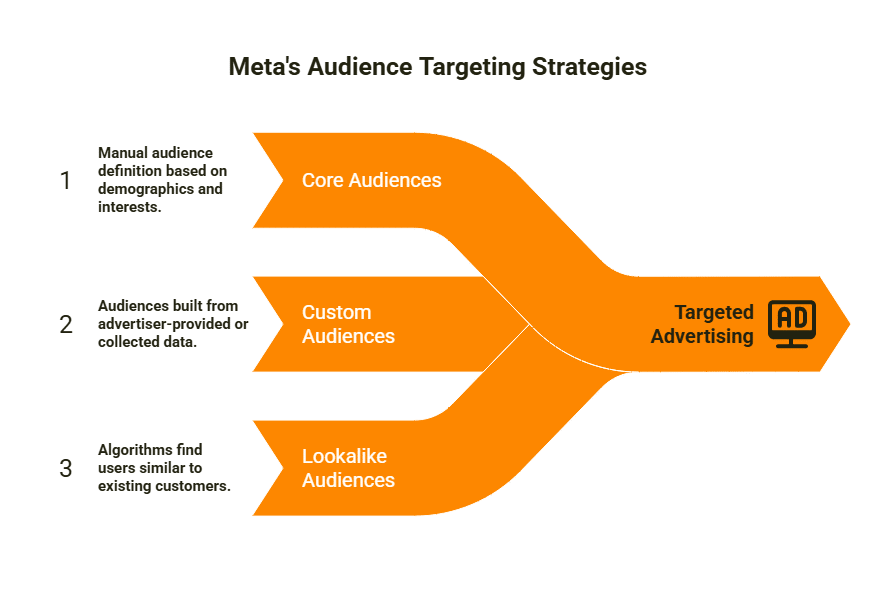
With this wealth of data, Meta offers advertisers several powerful targeting mechanisms:
- Core Audiences: Allows manual audience definition based on:
- Demographics: Age, gender, location, language, education, relationship status.
- Interests: Hobbies, entertainment, brands, public figures (inferred from behaviour).
- Behaviours: Purchase habits, travel patterns, device usage.
- Custom Audiences: Highly valuable audiences built from advertiser-provided or collected data:
- Customer Lists: Uploading emails or phone numbers of existing customers for targeting or exclusion.
- Website/App Activity: Targeting individuals who visited specific pages, viewed products, or performed app actions (requires Meta Pixel/SDK).
- Engagement Audiences: People who interacted with your brand’s content on Meta platforms (e.g., video watchers, page visitors).
- Lookalike Audiences: Created from a “source” Custom Audience, Meta’s algorithms find millions of other users with similar characteristics. This effectively reaches new potential customers resembling your valuable existing audience. Advertisers can choose similarity percentages.
The Ad Auction and Algorithm
When an advertiser launches a campaign, their ad enters Meta’s real-time ad auction, determining which ads are shown to users. Meta’s algorithm balances advertiser value with user experience by considering three main factors for each impression:
- Advertiser Bid: The amount the advertiser is willing to pay.
- Estimated Action Rates: How likely Meta believes a user is to take the desired action (e.g., click, purchase) if shown the ad, based on historical data.
- Ad Quality and Relevance: How relevant and engaging the ad is for the user, and its adherence to Meta’s policies.
Meta’s machine learning continuously learns and optimises, using conversion data (from the Meta Pixel) to refine predictions and improve ad delivery. More conversions lead to the algorithm becoming “smarter” at finding similar users likely to convert.
Meta’s ad targeting is a sophisticated blend of declared user data, observed behaviour (on and off-platform), and advanced predictive algorithms. This empowers advertisers to reach highly specific segments of its vast user base, making social media a potent, data-driven marketing channel.
How Often Should We Update Creatives?
In the highly visual world of social media marketing, creative assets are the primary storefront for brands. However, even the most brilliant ad can quickly succumb to ad fatigue, becoming stale and ineffective if seen too frequently by the same audience. Understanding the optimal refresh rate for your creatives is therefore paramount, directly impacting campaign performance, audience engagement, and return on investment (ROI).
Key Indicators for Creative Refresh
Determining when to update your creatives isn’t about a fixed schedule, but rather about monitoring specific data points and audience signals. Several key indicators demand a creative refresh:
- Declining Performance Metrics: This is the most crucial signal. Monitor your Click-Through Rate (CTR), Cost Per Click (CPC), Cost Per Lead (CPL), and Return on Ad Spend (ROAS). A sustained decline in CTR, coupled with rising costs and lower conversion rates, strongly indicates creative fatigue.
- Audience Saturation: For smaller, highly targeted audiences, ads wear out much faster. If your ad frequency (the average number of times a person sees your ad) starts to climb rapidly without a corresponding increase in results, your audience is likely saturated.
- Platform Dynamics: Fast-scrolling platforms like TikTok and Instagram burn through creatives more quickly than, for example, LinkedIn. Your refresh rate may need to be higher on these high-velocity channels.
- Negative Audience Feedback: Increased negative comments, users hiding your ads, or reporting them also signal that your creatives are no longer resonating.

Proactive Creative Strategies
Once indicators suggest fatigue, implementing proactive strategies is key to maintaining campaign vibrancy:
- Iterative Testing (A/B Testing): Instead of a complete overhaul, make small, targeted changes. Test different headlines, calls to action (CTAs), background visuals, or video intros. This allows for continuous optimisation without starting from scratch.
- Themed Variations: Develop multiple ad angles for the same product or service. Focus on different pain points, benefits, or use cases to appeal to diverse segments of your audience.
- User-Generated Content (UGC): Leverage authentic content created by your customers. UGC often feels more trustworthy and fresh, making it highly effective at cutting through traditional ad noise.
- Ad Rotation and Overhaul: Most platforms allow you to rotate multiple creatives within an ad set, keeping the experience fresh. When performance truly tanks across all variations, it’s time for a complete creative overhaul with entirely new concepts.

Practical Cadence & Continuous Optimisation
While data is paramount, a general guideline for actively managed campaigns often involves planning a creative refresh every 2-4 weeks for broader audiences or those with high ad spend.
For very niche, high-frequency campaigns, weekly updates might be necessary. Smaller budgets or evergreen content could suffice with monthly or quarterly checks.
Ultimately, regularly updating social media creatives isn’t merely good practice; it’s fundamental for sustained campaign success. By diligently monitoring performance, recognising fatigue signs, and implementing a strategic refresh cadence, marketers can ensure their social media advertising remains effective, engaging, and profitable, continuously driving genuine business growth.
What Types of Images Work Best for Engagement?
In the highly visual and rapidly scrolling social media feeds, a compelling image is often the sole opportunity for a brand to capture attention. Images are the frontline ambassadors for your message, making understanding their impact and optimal types crucial for effective social media marketing.
Key Characteristics of Effective Social Media Images
Before exploring specific types, universal qualities define strong social media imagery:
- High Quality and Resolution: Non-negotiable. Blurry or pixelated images instantly convey unprofessionalism. Invest in good photography or high-quality stock.
- Relevance and Context: The image must directly align with your accompanying text, audience interests, and overall message. It should immediately convey the post’s context.
- Emotional Appeal: Images evoking emotion – joy, curiosity, empathy, or aspiration – consistently perform well. People connect with feelings.
- Clear Focal Point: A strong image guides the viewer’s eye. Avoid cluttered visuals that confuse your message.
- Brand Consistency: Maintain consistent brand colours, typography (if used), and overall aesthetic to build recognition and a cohesive identity.
- Platform Optimisation: Images must be correctly sized and aspect-ratio optimised for each platform (e.g., square for Instagram feed, vertical for Stories) to prevent awkward cropping.

Types of Images That Deliver Strong Results
Leveraging the above characteristics, certain categories of images consistently prove effective in social media marketing:
- Authentic & User-Generated Content (UGC): Images featuring real people using your products, unposed, build immense trust and credibility. UGC feels genuine and acts as powerful social proof.
- High-Quality Product Shots (in context): While traditional product shots have a place, images showing products used in everyday scenarios, integrated into a lifestyle, or solving a problem, resonate more deeply. This is “product in action.”
- People-Centric Images: Humans are naturally drawn to faces. Images featuring diverse individuals, especially those expressing relatable emotions or engaging with your product/service, tend to generate higher engagement.
- Behind-the-Scenes (BTS) Content: Showing the human side of your brand – the team at work, the creation process, or office culture – humanises your business and builds rapport.
- Infographics & Data Visualisations: For brands dealing with complex information or statistics, transforming data into visually appealing infographics or charts makes it digestible, shareable, and highly engaging.
- Quotes & Text Overlays: Inspirational quotes, insightful tips, or compelling statistics overlaid on an attractive background can be highly shareable and effective for conveying quick, impactful messages.
- Before-and-After Images: Particularly effective for service-based businesses or products offering a visible transformation (e.g., fitness, beauty, renovation). They powerfully demonstrate results.
- Lifestyle Imagery: These images connect your brand with aspirational moments or desirable experiences, helping your audience envision themselves as part of the story you’re telling, fostering emotional resonance.
- Humorous Content: Appropriately-themed memes or light-hearted images can be highly shareable and effective for building brand personality and relatability, especially if they align with your brand’s voice and target audience.
 Maximising Visual Impact
The most effective images in social media marketing not only grab attention but also tell a story, evoke emotion, and resonate deeply with the target audience. Continuous A/B testing of different image types, closely monitoring performance, and adapting to platform-specific trends and audience preferences are crucial. By focusing on quality, relevance, and strategic variety, businesses can transform their social media imagery into a powerful engine for engagement and conversion.
Are Videos Better than Images for Social Marketing?
The engagement with social media marketing constantly shifts, bringing with it a frequent debate over content formats: are videos inherently better than images for generating results? While current trends and platform algorithms often seem to favour video, asserting one is universally “better” oversimplifies a nuanced reality. Both videos and static images possess distinct strengths and weaknesses, and their optimal use depends heavily on specific marketing objectives, target audience, platform dynamics, and available resources.
The Power of Video in Social Media Marketing
Video content has undeniably risen to prominence, often hailed as the future of social media. Its advantages are compelling:
- Enhanced Engagement and Immersion: Videos naturally capture attention for longer periods, increasing dwell time. They offer a more immersive experience, capable of conveying emotion, personality, and complex narratives in a way static images struggle to match.
- Superior Storytelling: Video excels at demonstrating products in action, offering tutorials, or providing behind-the-scenes glimpses. This ability to “show, not just tell” fosters deeper understanding and stronger emotional connections with the audience.
- Algorithmic Favour: Many social platforms actively prioritise video content (e.g., Instagram Reels, TikTok), often giving it greater organic reach in user feeds, which is invaluable for brand awareness.
- Increased Brand Recall: The combination of visual, auditory, and narrative elements in video can lead to higher brand recall compared to static images, making your message more memorable.
However, video production often demands greater resources, including higher costs, more time for creation and editing, and specialised skills. It also requires a stronger internet connection for users, which can be a barrier in some regions or on mobile data.

The Enduring Strength of Images in Social Media Marketing
Despite video’s ascent, static images remain a powerful and indispensable tool in a social media marketer’s arsenal. Their strengths are often overlooked but are equally critical:
- Instant Consumption: Images convey information rapidly. Users can grasp the essence of a message in a fraction of a second, making them highly effective for quick messaging or busy feeds.
- Versatility and Cost-Effectiveness: Images are quicker and cheaper to produce, offering immense versatility for quotes, infographics, striking product shots, event promotions, or relatable memes. This lower barrier to entry allows for more frequent posting and A/B testing.
- Direct Call to Action (CTA): For direct response campaigns, static images can often present a clear CTA and link more prominently without competing visual elements, potentially leading to higher click-through rates to websites or landing pages.
- Optimised for Certain Platforms: Platforms like Pinterest are inherently image-first, and even on Facebook or Instagram, a well-designed static image can outperform a poor video.
- Less Data Intensive: For users, images consume significantly less data, which can be a crucial consideration for those on limited mobile plans.
The Synergistic Approach: When to Use Which
The most effective social media marketing strategies rarely rely solely on one format. Instead, they embrace a synergistic approach, leveraging the unique strengths of both video and images based on specific objectives and the buyer’s journey:
- Brand Awareness & Engagement: Video often shines here, creating immersive experiences.
- Direct Conversions & Traffic: High-quality images with clear CTAs can be incredibly effective for driving clicks to product pages or lead forms.
- Education & Complex Information: Video excels at tutorials, while infographics (images) simplify complex data.
- Budget & Resource Constraints: Images offer a cost-effective way to maintain a consistent presence and test creative concepts before investing heavily in video.
- Platform Specificity: Tailor content to the platform’s primary format and audience behaviour.
Asserting that videos are definitively “better” than images in social media marketing is an oversimplification. While video offers unparalleled immersive storytelling and algorithmic favour, images provide instant impact, cost-effectiveness, and versatility. The truly successful strategy integrates both formats intelligently, recognising their respective strengths and deploying them strategically to meet diverse marketing goals.
What Social Media Platforms Should We Use?
For businesses attempting to invest in social media or digital marketing the vast digital / social marketing landscape, a primary strategic dilemma often arises: which social media platforms are truly essential? With a proliferation of networks, each boasting unique features, demographics, and content formats, simply being “everywhere” is often counterproductive and drains valuable resources.
The most effective approach isn’t about identifying a universally “best” platform, but rather making strategic choices that align precisely with a business’s specific objectives, target audience, industry, and available capabilities.
Key Factors for Strategic Platform Selection
A meticulous assessment of several critical factors should guide your platform selection process:
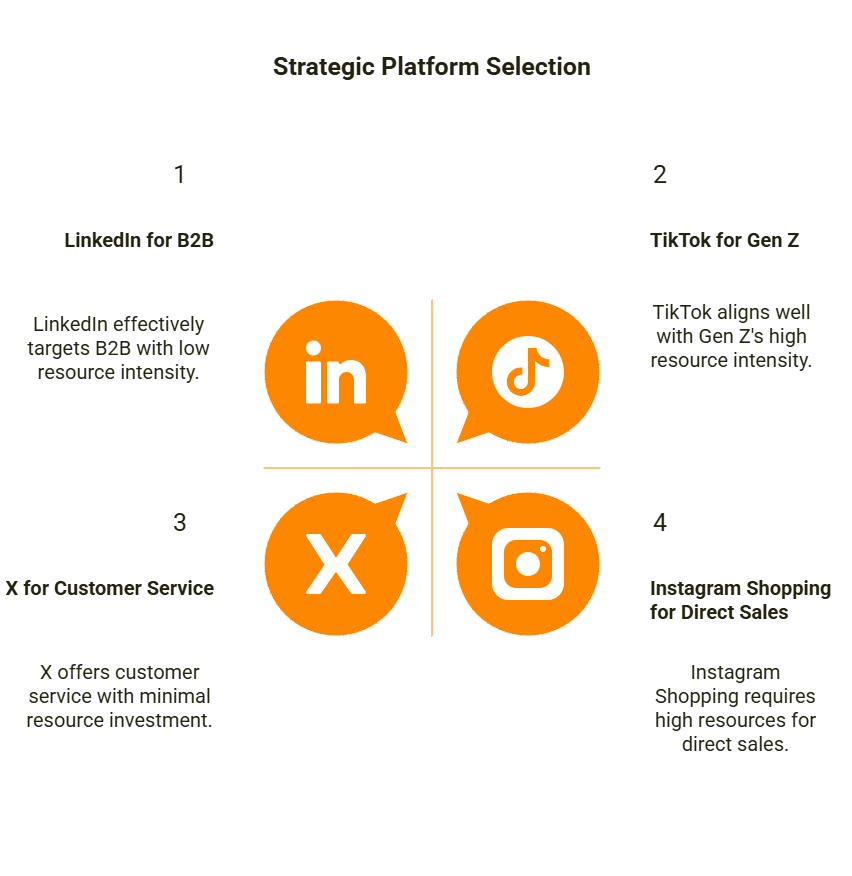
Define Your Target Audience: This is the paramount consideration. You must meticulously research where your ideal customers spend their time online. Understand their demographics (age, gender, location, income), psychographics (interests, values, lifestyle), and online behaviours. For instance, a brand targeting Gen Z might prioritise TikTok and Instagram, whereas a B2B software company would likely find more success on LinkedIn.
Identify Your Marketing Objectives: What do you genuinely aim to achieve with social media?
-
- Brand Awareness: Platforms with high reach and viral potential (e.g., TikTok, Instagram).
- Lead Generation: Networks with robust lead form capabilities and professional audiences (e.g., LinkedIn, Facebook).
- Direct Sales: Visually driven platforms integrated with e-commerce (e.g., Instagram Shopping, Pinterest).
- Customer Service/Engagement: Platforms allowing direct interaction (e.g., X, Facebook, Instagram).
- Thought Leadership: Networks where longer-form content and professional discussions thrive (e.g., LinkedIn). Aligning your objectives with platform strengths is crucial.
Analyse Your Industry & Content Type: Consider the nature of your business and the content you can realistically create. Highly visual industries (fashion, food, travel) thrive on Instagram, Pinterest, and TikTok. Service-based or technology firms often find long-form articles and professional discussions on LinkedIn more effective. A strong video strategy will lean towards platforms prioritising video, while image-heavy brands might favour Instagram or Pinterest.
- Assess Your Resources: Social media marketing demands investment – not just financial, but also time and skill. Do you have the capacity for consistent, high-quality video production required for TikTok, or are your resources better suited to crafting engaging images and concise copy for Instagram or X? Overstretching across too many platforms with insufficient resources leads to mediocre results across the board.
- Competitor Analysis: Research where your direct competitors are active and what strategies appear to be working for them. This can offer valuable insights into audience behaviour and content trends within your niche, while also highlighting potential gaps you could exploit.
Overview of Popular Platforms (Strategic Lens)
Rather than an exhaustive list, consider platforms through the lens of their typical strengths:
- Visual-First & Lifestyle: Instagram, TikTok, Pinterest. Ideal for consumer brands, fashion, food, travel, and showcasing products visually. TikTok excels in short, engaging videos; Pinterest for discovery and inspiration.
- Broad Audience & Community: Facebook. Still boasts massive user numbers, strong for community groups, diverse ad formats, and local business promotion.
- Professional & B2B: LinkedIn. Unrivalled for professional networking, thought leadership, talent acquisition, and B2B lead generation through articles, company pages, and targeted ads.
- Real-time & News/Service: X (formerly Twitter). Excellent for real-time news, public relations, customer service, and concise updates, though its audience engagement can be highly specific.
The Strategic Imperative: Quality Over Quantity
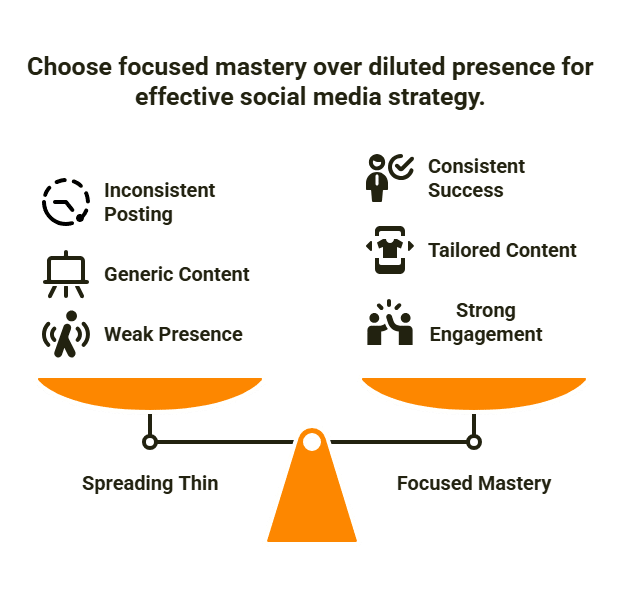
A common pitfall is attempting to establish a presence on every conceivable platform. This often dilutes effort, resulting in inconsistent posting, generic content, and a failure to build a strong presence anywhere.
The most effective strategy is to select a core 2-3 platforms where your target audience is most active and where your content type can genuinely thrive. Master these platforms, invest in creating compelling, tailored content for them, and measure your results diligently. Once you achieve consistent success on these core channels, then – and only then – consider expanding your presence cautiously.
The decision of which social media platforms to utilise is a strategic one, not a popularity contest. By rigorously defining your audience and objectives, understanding your industry and content capabilities, and assessing your resources, businesses can make informed choices that drive meaningful engagement, leads, and sales, rather than merely making noise.
How Does Meta Advertising Work?
Meta Advertising, encompassing the powerful platforms of Facebook, Instagram, Messenger, and the Audience Network, provides businesses with an unparalleled opportunity to connect with a global audience. At its core, Meta’s advertising ecosystem is a sophisticated, data-driven system that operates on a real-time auction model, designed to show the most relevant ads to the most receptive users at the most opportune time. Understanding its mechanics is key to running successful and profitable campaigns.
1. Audience Targeting: The Foundation of Meta Advertising
The defining feature of Meta’s advertising is its granular audience targeting capabilities. Meta leverages the immense amount of data it collects from user profiles, interests, and on-platform behaviour to allow advertisers to reach highly specific groups of people. This goes far beyond basic demographics. Advertisers can target users based on:
- Core Audiences: Basic demographics such as age, gender, location, and language.
- Interests: Based on pages a user has liked, groups they have joined, and topics they have engaged with (e.g., “digital marketing,” “organic gardening,” “fashion”).
- Behaviours: Based on purchasing history, device usage, travel patterns, and other observable actions.
- Custom Audiences: Created from a business’s own data, such as a customer email list, a list of people who have visited their website (via the Meta Pixel), or a list of people who have interacted with their social media pages.
Lookalike Audiences: Built from a Custom Audience, Lookalike Audiences are a powerful tool that uses machine learning to find new users who share similar characteristics with your existing customers.
2. The Ad Auction: Real-Time Bidding
Unlike a traditional advertising model where you pay a fixed price for an ad spot, Meta’s system is a dynamic auction. When an ad is eligible to be shown, it enters an auction against other advertisers who are competing for the same audience. The winner of the auction is determined by three key factors:
- Advertiser Bid: The amount an advertiser is willing to pay for a specific action (e.g., a click, a conversion).
- Estimated Action Rates: Meta’s prediction of how likely a user is to take the desired action, based on their past behaviour.
- Ad Quality and Relevance: An assessment of the ad’s quality, originality, and relevance to the user. A high-quality, engaging ad with good relevance to the target audience will have a higher chance of winning the auction, even with a slightly lower bid.
This auction model ensures that ads are not only cost-effective but also as relevant as possible to the user’s interests, which improves the overall user experience on the platform.
3. Campaign Structure: A Hierarchical Approach
Meta’s campaign structure follows a clear hierarchy that allows for organised and targeted advertising:
- Campaign: The highest level of the structure, where you set your overarching marketing objective (e.g., brand awareness, traffic, leads, sales).
- Ad Set: Within each campaign, you can have multiple ad sets. This is where you define your targeting (audience, location, demographics), budget, schedule, and bidding strategy. You might have one ad set targeting men aged 25-34 and another targeting women aged 35-44 for the same campaign objective.
- Ad: The lowest level, where you create the actual creative content. This includes the ad copy, images, videos, and a call-to-action button. You can have multiple ads within a single ad set to test different creatives and messages.
4. Ad Formats and Placements
Meta offers a wide variety of ad formats to suit different campaign objectives and creative assets:
- Image and Video Ads: The most common formats. Videos, especially short-form videos like Reels, are highly effective for engagement.
- Carousel Ads: A series of scrollable images or videos, ideal for showcasing multiple products or telling a sequential story.
- Collection Ads: A full-screen mobile experience designed for e-commerce, allowing users to browse products seamlessly.
- Messenger Ads: Ads that appear in a user’s Messenger inbox.
These ads can be placed across all of Meta’s properties, including the Facebook and Instagram Feeds, Stories, Reels, in-stream video, and in Messenger.
5. Tracking and Optimisation with the Meta Pixel
The Meta Pixel is a small piece of code that you install on your website. It tracks user actions on your site (e.g., page views, add to carts, purchases) and sends this data back to Meta. This is crucial for:
- Conversion Tracking: Attributing sales and leads directly back to specific ad campaigns.
- Optimisation: Allowing Meta’s algorithms to find and target users who are most likely to convert on your website.
- Remarketing: Creating Custom Audiences of people who have visited your site but haven’t purchased yet.
Meta Advertising is a highly effective, data-rich ecosystem that, when used strategically, allows businesses to reach the right people with the right message at the right time, driving tangible business results.

How Does Advertising Compare on Meta vs Instagram?
Choosing where to advertise within Meta’s vast ecosystem is a critical decision for any business seeking to maximise its digital reach. While Facebook and Instagram are both owned by Meta and share the same advertising platform, they are distinct environments with different audiences, user behaviours, and advertising strengths.
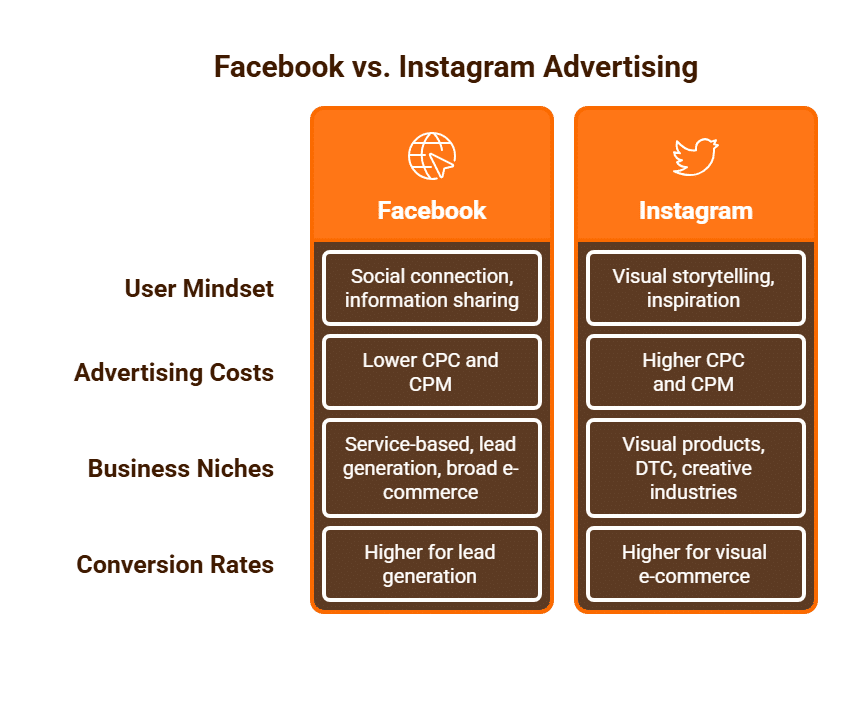
A successful campaign hinges on understanding these nuances and strategically aligning your marketing objectives with the right platform. This FAQ will compare advertising on Facebook versus Instagram, providing considerations for costs, suggested business niches for each platform, and an analysis of conversion rates to guide your advertising strategy.
Understanding the Platforms
The core difference between Facebook and Instagram lies in the mindset of their users and the nature of the content they consume.
- Facebook is a platform built for social connection, community, and information sharing. Its user base is broad, with a significant presence across a wide range of age groups and demographics. Users often spend time reading articles, engaging in groups, and connecting with friends and family. This makes Facebook an ideal platform for delivering detailed content, such as blog posts or a long-form story about your brand. The user’s mindset here is often one of discovery and passive engagement.
- Instagram is a visually driven platform centred on inspiration, visual storytelling, and aspirational content. Its user base is typically younger, with a strong focus on aesthetics, trends, and lifestyle. Users scroll through visually appealing content, follow influencers, and discover new brands through imagery and short-form video (Reels). The mindset here is one of inspiration and active consumption of visual media.
Cost Considerations
Advertising costs on both platforms are determined by a dynamic ad auction, where the final price is influenced by your bid, the audience’s engagement with your ad, and the competition. However, there are general trends in cost that differentiate the two:
- Facebook can often offer a lower Cost-Per-Click (CPC) and a lower overall Cost-Per-Mille (CPM – cost per thousand impressions). This is due to its larger and more diverse audience, which can make it easier to find a relevant group of people at a more affordable price. For businesses focused on lead generation, especially B2B or service-based companies, Facebook often proves to be more cost-effective.
- Instagram typically has a slightly higher CPC and CPM. This is a reflection of its highly engaged and often younger, more affluent audience, which can make ad inventory more competitive. While the cost per click may be higher, the visual nature of the platform can lead to a better quality of click for certain products and a stronger return on ad spend (ROAS) if the creative is compelling.
Suggested Business Niches
The distinct nature of each platform makes them better suited for different types of businesses and marketing objectives.
- Facebook is an ideal platform for service-based businesses (e.g., financial services, legal firms, real estate) where the conversion requires detailed information or a longer consideration cycle. The platform’s ability to host longer ad copy, link to extensive landing pages, and use native lead forms makes it excellent for lead generation. For e-commerce, Facebook is effective for products that appeal to a broad demographic, such as home goods, family-oriented products, and items with a less purely aesthetic focus.
- Instagram is the go-to platform for visual products and aesthetic-driven brands. Industries like fashion, beauty, fitness, travel, and food thrive on Instagram’s visual-first approach. It is also the perfect platform for direct-to-consumer (DTC) brands and creative industries, where building a strong brand identity and a loyal following through aspirational content is key. Instagram’s shoppable posts and integration with the “Shop” tab make it a frictionless path to purchase for users who are already in an inspired mindset.
Conversion Rates
Conversion rates are not universally better on one platform. They are a direct result of how well the ad creative and offer match the platform’s user base and the user’s mindset.
- Facebook often sees a higher conversion rate for lead generation campaigns, primarily because its native lead forms provide a seamless experience, and users are accustomed to providing their information. For e-commerce, it can perform well for products that require a longer customer journey, where an ad might be the first touchpoint in a multi-day research process.
- Instagram can have higher conversion rates for visual e-commerce products where the user is inspired to buy immediately. The platform’s shoppable features and immersive ad formats (like Stories and Reels) can create a direct path from discovery to purchase. However, the higher CPCs and CPMs can sometimes result in a higher overall Cost-Per-Acquisition (CPA), requiring advertisers to carefully manage their budgets and ensure their campaigns are profitable.
The choice between advertising on Facebook or Instagram is not a zero-sum game. The most successful advertisers often use both platforms in a complementary fashion. They might leverage Facebook for broad reach and lead generation, using its robust targeting and analytics to find new customers.
Simultaneously, they use Instagram to build brand identity and a strong emotional connection through visually stunning, aspirational content. The key to a winning strategy is to move beyond simply using the platforms and to strategically align your social marketing objectives, ad formats, and creative messaging with the unique strengths of each platform and the mindset of its users.
What Other Social Media Platforms Allow Paid Ads?
Beyond the Meta ads platform of Facebook and Instagram, there’s a diverse and powerful range of social media platforms that also provide a platform for paid advertising. These channels cater to different audiences and offer unique targeting and ad formats, enabling businesses to connect with potential customers in a variety of contexts.
A strategic digital marketing plan often involves a multi-platform approach, leveraging the specific strengths of each channel to achieve different objectives, from brand awareness and lead generation to direct sales.
LinkedIn: The Professional Network
LinkedIn is the world’s leading professional social network, making it the premier platform for B2B (business-to-business) advertising. Its audience is comprised of professionals, executives, and decision-makers, providing a unique environment for reaching a highly qualified and specific demographic.
- Audience Targeting: The targeting on LinkedIn is exceptionally granular, allowing advertisers to reach users based on job title, industry, company size, seniority, professional skills, and educational background. This precision is invaluable for businesses selling high-value services, software, or products to other businesses.
- Ad Formats: LinkedIn offers a variety of ad formats, including Sponsored Content (native ads in the feed), Sponsored Messaging (ads delivered directly to a user’s inbox), Text Ads, and Lead Gen Forms, which capture user data directly on the platform without requiring a click to a landing page.
- Best For: B2B lead generation, brand building in a professional context, and recruiting.
X (Formerly Twitter): The Real-Time Conversation
X is a microblogging platform known for its fast-paced, real-time conversations and breaking news. Advertising on X allows brands to tap into this immediacy, engaging with users during major events or relevant discussions.
- Audience Targeting: X’s targeting is powerful, allowing you to reach users based on keywords they use in their tweets, specific conversations they are engaging in, and the followers of a particular account.
- Ad Formats: Ad formats include Promoted Ads (text, image, and video), Follower Ads (to gain more followers), and X Takeovers, which are high-impact ads that appear at the top of the timeline.
- Best For: Driving conversations, real-time engagement, brand awareness, and reaching a younger, culturally-aware audience.
TikTok: The Short-Form Video Giant
TikTok has rapidly grown into a dominant social media force, particularly among Gen Z and millennials. It is an entertainment platform built around short-form, highly engaging video content. Advertising on TikTok requires a native, creative approach that feels less like a traditional ad and more like a piece of organic content.
- Audience Targeting: TikTok’s targeting uses its sophisticated algorithm to reach users based on demographics, interests, and their past video-watching behaviour.
- Ad Formats: The most popular ad formats are In-Feed Ads, which appear natively in the “For You” feed, and Spark Ads, which boost an existing piece of organic content. TikTok also offers more premium options like Brand Takeovers and TopView Ads, which have a high visual impact.
- Best For: Building brand awareness, driving traffic to a younger demographic, and creating highly viral, entertaining video content.
Pinterest: The Visual Discovery Engine
Pinterest functions as a visual discovery engine, where users go to find ideas and inspiration for various projects, hobbies, and purchases. This user mindset makes it a powerful platform for e-commerce and visual brands.
- Audience Targeting: Pinterest allows you to target users based on their demographics and, more importantly, their interests and the specific keywords they search for on the platform.
- Ad Formats: Ad formats are primarily visual, including Standard Pins, Video Pins, and Collection Ads, which showcase multiple products.
- Best For: E-commerce, visual products (e.g., home décor, fashion, beauty), lead generation via content (e.g., e-books, recipes), and driving sales.
Snapchat: The Ephemeral Messenger
Snapchat is a mobile-first platform known for its ephemeral content and younger user base. Its advertising platform offers unique opportunities to reach a Gen Z audience with fun, interactive ad formats.
- Audience Targeting: Snapchat’s targeting is based on demographics, interests, and its own unique data points.
- Ad Formats: Ad formats include Snap Ads (full-screen video), Story Ads (multiple Snap Ads in a single story), Collection Ads, and AR Lenses, which are highly interactive and engaging.
- Best For: Reaching a younger demographic, driving app installs, and creating interactive branded experiences.
The social media advertising options extend far beyond Meta’s core platforms. By understanding the unique audience and advertising capabilities of channels like LinkedIn, X, TikTok, Pinterest, and Snapchat, businesses can build a multi-channel strategy that effectively reaches their target audience at every stage of the customer’s experience.

What is the Best Way to Advertise on YouTube?
YouTube is the second most searched website on the planet, so it’s not just a content platform, but is also a highly effective advertising channel. With billions of users watching countless hours of video on a daily basis, it offers an unparalleled opportunity to reach diverse audiences through compelling visual storytelling. The “best way” to advertise on YouTube is not a single strategy but a strategic alignment of your campaign goals with the right ad format and a precise targeting approach.
1. Define Your Campaign Goals
Before you choose an ad format, you must have a clear objective. Your goal will dictate the type of ad you use and how you measure success.
- Brand Awareness: The goal is to get as many people as possible to see your brand message. Metrics: Impressions, reach, view-through rate.
- Consideration: The goal is to encourage users to think about your brand and products. Metrics: Clicks, views, engagement rate.
- Conversions: The goal is to drive a specific action on your website, like a sale or a lead. Metrics: Conversions, Cost-Per-Acquisition (CPA), Return on Ad Spend (ROAS).
2. Choose the Right Ad Format
YouTube offers a variety of ad formats, each with unique characteristics suited to different objectives:
- Skippable In-stream Ads: These ads play before, during, or after a video and can be skipped after 5 seconds. They are ideal for brand awareness and consideration. The best part is you only pay if a user watches for 30 seconds (or the full ad if shorter) or clicks, making it a cost-effective way to get your brand seen.
- Non-skippable In-stream Ads: At 15 seconds or less, these ads cannot be skipped. They are perfect for delivering a short, impactful message that you want every viewer to see. They are best for campaigns focused on brand awareness and ensuring your message is fully delivered.
- Bumper Ads: These are short, 6-second, non-skippable ads that run before a video. They are excellent for creating a memorable, concise brand message. Bumper ads are typically used in combination with other ad formats to reinforce your message and are a powerful tool for brand awareness.
- In-feed Video Ads: These ads appear on the YouTube homepage, in search results, or in the “Up Next” section, blending in with other video content. They consist of a thumbnail and a headline and only play when a user clicks them. These ads are great for campaigns focused on consideration, as they attract clicks from users who are actively interested in your content.
- Outstream Ads: These ads appear on Google’s partner websites and apps, outside of YouTube. They start playing with the sound off as they scroll into view. They are a good way to extend the reach of your video campaign beyond YouTube to a wider audience.
3. Master Your Targeting Strategy
The most compelling video ad is useless without a precise targeting strategy. YouTube offers a powerful array of options to reach your ideal audience:
- Demographics: Target users by age, gender, parental status, and location.
- Audiences:
- Affinity & Custom Affinity: Target users based on their interests and passions (e.g., “Foodies,” “Outdoor Enthusiasts”).
- In-market: Target users who are actively researching and showing signs of a purchase intent for a specific product or service.
- Remarketing: This is one of the most effective targeting methods, allowing you to show ads to people who have already visited your website or interacted with your videos.
- Content:
- Keywords: Target your ads to appear on videos related to specific keywords.
- Placements: For granular control, you can choose to place your ads on specific YouTube channels, videos, or apps.
4. Optimisation and Best Practices
- Compelling Creative: The quality of your video creative is paramount. The first 5 seconds are crucial for grabbing a viewer’s attention.
- Clear Call-to-Action (CTA): Tell your viewers what to do next with a clear and compelling CTA, whether it’s “Shop Now,” “Learn More,” or “Subscribe.”
- Testing: Continuously A/B test different ad creatives, targeting parameters, and ad formats to see what delivers the best results.
The best way to advertise on YouTube is a combination of choosing the right ad format for your goals, leveraging YouTube’s powerful targeting tools to reach your ideal audience, and creating compelling video content that captures attention. By strategically aligning these elements, you can turn YouTube into a powerful engine for brand growth and conversions.

Should We Use X (Formerly Twitter) or TikTok for Paid Ads?
When making decisions on investing in social media advertising, businesses are faced with a crucial strategic decision: allocating budget to platforms that offer the highest return on investment (ROI).
Among the major players, X (formerly Twitter) and TikTok present fundamentally different advertising environments. X is a real time conversation engine built on text and immediate news, while TikTok is an immersive, short form video platform driven by entertainment and discovery. Determining which platform provides the “most impact” hinges entirely on a brand’s specific objectives, target demographic, and creative assets.
X (Formerly Twitter): The Real-Time Conversation Engine
X’s core dynamic is speed, immediacy, and relevance. It operates primarily as a global town square for news, trending topics, and professional commentary.
Audience and Content Dynamics
The typical X audience is characterised by a strong bias towards professionals, news consumers, journalists, and active commentators. The demographic tends to be older than TikTok’s, often falling into the 30+ age bracket. This makes X an invaluable tool for:
- B2B and Finance: Reaching decision makers based on their job titles and professional discourse.
- Customer Service and Crisis Communication: Utilising the platform’s real time nature to manage reputation and engage in high velocity conversations.
- Topical Relevance: Ads thrive when they tie into a trending hashtag, a live event, or a breaking news story, offering immediacy that no other platform can match.
Advertising Impact
Advertising on X delivers its greatest impact in precision and immediacy. Campaigns often focus on driving traffic, gathering leads through lead generation cards, and ensuring the brand message dominates a specific, timely conversation.
The conversion path is typically a click to a landing page, rewarding concise, compelling copy and direct calls to action. The impact is measurable in terms of share of voice during key events and efficiency in capturing high intent, text based queries.
TikTok: The Entertainment and Discovery Platform
TikTok’s dominance lies in its immersive, full screen video format and its powerful discovery algorithm. It operates less like a social network and more like an entertainment channel.
Audience and Content Dynamics
TikTok’s audience is heavily skewed towards Gen Z and Millennials (the 16 to 35 age group). They use the platform for entertainment, cultural trends, and organic product discovery. The defining feature is the “For You Page” (FYP), where content from accounts a user doesn’t follow frequently appears.
- Authenticity is Key: Ads must feel native to the FYP experience. Highly polished, traditional advertisements often fail; the most impactful creative is often user generated or mimics organic video style.
- Product Discovery: TikTok is a powerful engine for spontaneous sales, famously driving the “TikTok Made Me Buy It” phenomenon. Users come across products naturally, leading to high volume, impulse purchases driven by creative trends.
Advertising Impact
TikTok delivers its greatest impact in mass reach and viral momentum. Its ad formats, such as In-Feed Ads and the high impact Brand Takeover, offer unmatched visual immersion. For driving brand awareness among younger demographics, TikTok can achieve exceptionally low CPMs (Cost Per Mille) for the sheer volume of unique users reached. The impact is measurable in terms of viral reach, trend adoption, and rapid brand familiarity. Conversions, often tracked through its native shopping features, reward brands that successfully entertain their audience first.
Strategic Alignment for Maximum Return
The choice between X and TikTok should be determined by the business goal and the nature of the product. Neither is inherently “more effective” than the other; they are simply effective at different things:
- Use X for Precision and Professional Reach: If your goal is to generate B2B leads, manage your brand narrative, or target a specific demographic based on professional title or real time intent, X provides the better mechanism for precision and dialogue.
- Use TikTok for Mass Awareness and Visual Sales: If your goal is to build rapid brand recognition, drive cultural relevance, or sell a visually appealing product to a younger demographic, TikTok’s video engine and viral distribution model offer the highest impact.
The most potent strategy often involves a multi channel approach, using X to capture intent and conversation, while simultaneously leveraging TikTok to build widespread visual awareness and cultural momentum around the brand.
Is Short Form or Long Form Content Better for Social Media?
The debate over whether short form or long form content is a contentious debate on social media platforms is no longer a binary choice; it is a nuanced strategic question. Historically, social media was the undisputed domain of the short, sharp update.
However, as platforms evolve and user attention fragments, both formats have carved out essential roles in a modern digital strategy. For professional marketers, understanding the distinct purpose, strengths, and weaknesses of each is crucial for driving engagement, awareness, and conversion.
The optimal choice is rarely “one or the other,” but rather “where and why.”
The Power of Short Form Content
Short form content typically defined as videos under 60 seconds (like TikToks and Instagram Reels), brief text posts, carousels, or fast paced visual graphics is engineered for instant gratification and high reach.
Strengths of Short Form:
- Maximum Reach and Virality: The algorithms of major platforms like TikTok and Instagram heavily favour short form video due to its rapid consumption rate. This format is designed for discovery, meaning brands can quickly reach new, unengaged audiences and achieve viral growth potential. A concise, engaging Reel often offers far greater organic reach than a lengthy, detailed post.
- Attention Capture: In a cluttered feed, short, high impact visuals are the most effective tool for stopping a user’s scroll. They deliver value, entertainment, or a core message within the first few seconds, capitalising on diminishing attention spans.
- Frequency and Consistency: Short form content is faster and cheaper to produce, allowing brands to maintain a high frequency of posting. Consistency is a vital ingredient for algorithm favourability and audience retention, making short content the backbone of a daily social media presence.
- Traffic Conversion (Top-of-Funnel): Its primary role is to drive awareness and traffic. A short clip can serve as a compelling hook to a longer article, a product page, or a sign-up form, making it the perfect top of funnel entry point.
Limitations:
Short form struggles with depth and authority. It is difficult to build trust or convey complex product features in a 30-second clip, leading to lower quality engagement (likes over conversions) if not strategically linked to other assets.
The Strategic Value of Long Form Content
Long form content, spanning deep dive video tutorials (5+ minutes on YouTube), detailed LinkedIn articles, multi-slide educational carousels, or comprehensive written threads on X (formerly Twitter), focuses on education, authority, and sustained engagement.
Strengths of Long Form:
- Building Authority and Trust: Longer content allows brands to showcase deep expertise and thought leadership. This is critical for B2B companies, financial services, or any brand selling a high value or complex product. A user who spends five minutes consuming your detailed video tutorial is building a higher level of trust than one who simply double taps a Reel.
- High Quality Engagement and Loyalty: Time spent consuming content is a strong signal to platforms that the content holds genuine value. Longer watch times lead to higher quality engagement, stronger audience loyalty, and improved customer lifetime value (CLV).
- SEO and Searchability: Longer videos on platforms like YouTube (which is itself the second largest search engine) are keyword rich and highly searchable. A well optimised, detailed video will continue to draw relevant organic traffic for months, long after a short form trend has passed.
- Nurturing (Bottom of Funnel): Long content is superior for nurturing leads and driving conversions. If a customer needs to understand the intricate differences between product models before committing to a $500 purchase, a long form breakdown is essential.
Limitations:
Long form content is often gated by the algorithm, meaning it is typically shown to existing followers or warm audiences who already trust the brand. It is also more time intensive and expensive to produce.
The Strategy: A Hybrid Approach
The most effective social media strategies employ a hybrid model, utilising both formats to cover the entire customer journey:
| Content Format | Primary Goal | Funnel Stage | Recommended Platform Examples |
| Short-Form | Awareness, Virality, Attention | Top-of-Funnel (ToFu) | TikTok, Instagram Reels, YouTube Shorts |
| Long-Form | Education, Authority, Trust | Middle/Bottom-of-Funnel (MoFu/BoFu) | YouTube, LinkedIn Articles, Facebook Watch |
For instance, a new clothing brand might film a 30-second, high energy Reel showcasing the “5 ways to style a new jacket” (Short-Form, ToFu). The voiceover or caption then directs interested users to a YouTube video which features a detailed, 10-minute look book and fit guide (Long-Form, MoFu). The YouTube video, in turn, links directly to the product page for the final purchase.
This strategy maximises the unique advantage of each format: short form content grabs attention cheaply, and long form content converts that attention into valuable customers by providing necessary context and trust.
Ultimately, deciding which format is “better” depends on the objective. If a brand needs rapid scaling and brand awareness, short form is the tactical priority. If the goal is to establish deep domain expertise and nurture high value customers, long form must be the strategic investment. Success on modern social platforms demands the discipline to produce short, shareable hooks while maintaining a library of authoritative, long form content that proves a brand’s value.
What is the Best Action Plan to Advertise on Meta?
Whether you are chasing leads, selling products or growing a brand, Meta (comprising Facebook, Instagram, Messenger, and Audience Network) remains an undeniable powerhouse for reaching vast and diverse audiences. For businesses in Australia, mastering Meta advertising is crucial for brand awareness, lead generation, and driving sales. However, simply “boosting a post” is far from a comprehensive strategy. A robust action plan, meticulously executed, is required to unlock the platform’s full potential.
Here’s a strategic action plan to effectively advertise on Meta:
Phase 1: Strategic Foundation & Setup
Before spending a single pound, lay the groundwork for success.
- Define Clear Objectives: What do you want to achieve?
- Brand Awareness: Get your brand seen by a broad, relevant audience.
- Lead Generation: Collect email addresses, phone numbers, or other contact details.
- Website Traffic: Drive users to specific pages on your website (e.g., blog posts, product pages).
- Conversions (Sales/Enquiries): Encourage direct purchases, sign-ups, or form submissions.
- App Installs: Promote your mobile application. Your objective will dictate your campaign structure and bidding strategy.
- Install the Meta Pixel (or Conversions API): This is non-negotiable. The Meta Pixel is a piece of code that tracks user behaviour on your website (page views, add-to-carts, purchases). It’s vital for:
- Tracking Conversions: Accurately measure the effectiveness of your ads.
- Optimisation: Allows Meta’s algorithm to find more users likely to convert.
- Retargeting: Build custom audiences of people who have interacted with your website. The Conversions API (CAPI) offers a server-side solution for enhanced data privacy and accuracy, often used in conjunction with the Pixel.
- Set Up Business Manager (Meta Business Suite): Centralise all your Meta assets (ad accounts, pages, pixels, catalogues). This provides a professional dashboard for managing multiple ad accounts, granting permissions, and scaling your operations.
- Create Your Ad Creative & Copy: This is where your brand’s message comes to life.
- Creative Variety: Prepare a range of formats: high quality images, short video clips (Reels optimised), carousels, and stories. Conduct A/B split tests for different visuals to see what resonates.
- Platform-Specific Design: Design creatives specifically for Instagram Stories (9:16 aspect ratio), Facebook Feed (1:1 or 4:5), and Reels.
- Compelling Copy: Craft concise, benefit driven headlines and primary text. Include a clear Call to Action (CTA). For the Australian audience, ensure language is appropriate and clear.
- Value Proposition: Clearly communicate “What’s in it for them?”
Phase 2: Audience Targeting & Segmentation
Meta’s strength lies in its sophisticated targeting capabilities.
- Core Audiences (Demographic, Interest & Behavioural):
- Demographics: Target by age, gender, location (e.g., specific AU cities, postcodes), language, education, job title, etc.
- Interests: Target users based on pages they like, topics they engage with (e.g., “small business owners,” “sustainable fashion,” “football fans”).
- Behaviours: Target based on purchase behaviour, device usage, or travel habits.
- Custom Audiences (Retargeting Powerhouse):
- Website Visitors: Target people who have visited your website (tracked by the Meta Pixel). Segment these (e.g., “added to cart but didn’t purchase,” “viewed specific product page”).
- Customer Lists: Upload your existing customer email or phone number lists to target loyal customers or exclude them from certain campaigns.
- Engagement Audiences: Target users who have engaged with your Facebook Page, Instagram Profile, or watched your videos.
- Lookalike Audiences (Scalable Growth):
- Based on your Custom Audiences, Meta’s algorithm finds new users who share similar characteristics with your existing customers or high value website visitors. This is excellent for expanding your reach with highly relevant prospects. Start with 1% lookalikes for precision, then test 2-5% for broader reach.
Phase 3: Campaign Structure & Budgeting
Efficient allocation of resources is key.
- Choose the Right Campaign Objective: Align this with your Phase 1 goals (e.g., “Conversions” for e-commerce sales, “Lead Generation” for collecting emails).
- Campaign Budget Optimisation (CBO): Meta’s AI can distribute your budget across ad sets (audiences) within a campaign, automatically allocating more spend to the best performing ones. This is generally recommended for efficiency.
- Ad Set Structure: Organise your audiences into separate ad sets. This allows you to test different targeting parameters (e.g., one ad set for interest-based targeting, another for a lookalike audience, and one for retargeting).
- Ad Placement: Let Meta’s automatic placements optimise for performance across Facebook Feed, Instagram Feed, Stories, Reels, Audience Network, and Messenger. However, if specific placements consistently underperform or your creative is not suited for certain placements (e.g., a non-vertical video in Stories), you can adjust manually.
- Bidding Strategy: For conversion focused campaigns, use Lowest Cost (Meta optimises for the cheapest conversion) or Cost Cap (set a maximum CPA you’re willing to pay).
Phase 4: Monitoring, Testing & Optimisation
Advertising is an iterative process. Continual refinement is essential.
- Monitor Key Metrics: Regularly review:
- Reach & Impressions: How many people saw your ads.
- Click-Through Rate (CTR): How many people clicked your ads relative to impressions.
- Cost Per Click (CPC): The cost of each click.
- Cost Per Result (CPR) / Cost Per Acquisition (CPA): The cost to achieve your objective (e.g., cost per purchase, cost per lead).
- Return on Ad Spend (ROAS): Crucial for e-commerce, measuring revenue generated per pound spent.
- A/B Testing (Split Testing): This is paramount for improvement. Test:
- Ad Creatives: Different images, videos, headlines.
- Ad Copy: Short vs. long, different CTAs.
- Audiences: Different interest groups, lookalike percentages.
- Landing Pages: Ensure your website experience is optimised.
- Iterate and Refine: Pause underperforming ads/ad sets. Reallocate budget to winners. Create new variations based on insights. Refresh creatives frequently to combat ad fatigue, where users become blind to ads they’ve seen too often.
By meticulously following this action plan, Australian businesses can move beyond basic social media promotion to harness the sophisticated advertising capabilities of Meta, driving tangible results and achieving their marketing objectives in a highly competitive digital arena.
What are Lookalike Audiences in Social Media Ads?
When considering investing in social media advertising, precision targeting is the cornerstone of effective campaigns. While interest-based and demographic targeting are fundamental, truly scaling successful campaigns often hinges on finding new prospects who share the characteristics of your existing, high value customers.
This is precisely the power of Lookalike Audiences, a sophisticated targeting tool available across major social platforms like Meta (Facebook & Instagram), Google, and TikTok. For Australian businesses, leveraging Lookalikes can significantly amplify reach, improve campaign efficiency, and drive superior returns on ad spend.
What are Lookalike Audiences?
A Lookalike Audience is a targeting option that allows advertisers to reach new users who are statistically similar to a “source audience” (also known as a seed audience) that they already possess or control. The social media platform’s algorithms analyse the unique attributes and behaviours of the people in your source audience and then identify other users on the platform who exhibit similar patterns.
Think of it like this: if you have a list of your best customers, a Lookalike Audience campaign asks the social media platform, “Find me more people just like these ones.” The platform’s powerful AI then sifts through its vast user data to identify individuals who are most likely to be interested in your offerings because they share characteristics with your proven customer base.
How Lookalikes are Created: The Source Audience
The effectiveness of a Lookalike Audience is directly tied to the quality and size of its source audience. Common source audiences include:
- Website Visitors (via Pixel Data): This is one of the most common and powerful sources. By installing the platform’s tracking pixel (e.g., Meta Pixel, Google Analytics tag), you can create Custom Audiences of users who have:
- Visited any page on your website.
- Visited specific product pages.
- Added items to their cart but didn’t purchase (abandoned carts).
- Completed a purchase (highly valuable for finding more buyers).
- Customer Lists: You can upload a CSV file of your existing customer data (email addresses, phone numbers, first names, last names). The platform matches this data to its user base, creating a custom audience that then serves as the seed for your Lookalike. This is excellent for targeting people similar to your most loyal or highest-spending customers.
- Engagement Audiences: Users who have engaged with your social media content, posts, or videos. This could include people who:
- Liked, commented, or shared your Facebook/Instagram posts.
- Watched a certain percentage of your video content.
- Visited your profile page.
- App Activity: For businesses with mobile apps, you can create source audiences from users who have installed, launched, or performed specific actions within your app.
The “Percentage” Factor: Sizing Your Lookalike
When creating a Lookalike Audience, you typically choose a percentage size, often ranging from 1% to 10% (e.g., “1% Lookalike Audience of my AU customers”). This percentage refers to the proportion of the total population in your chosen country/region (e.g., Australia) that most closely resembles your source audience.
- 1% Lookalike: This is the most precise and highly targeted segment. It includes users who are the most similar to your source audience, resulting in smaller audience sizes but often higher relevance and conversion rates.
- Larger Percentages (e.g., 5-10% Lookalike): These audiences are broader and include a larger pool of users, but their similarity to your source audience is lower. They offer greater reach but might have a slightly lower conversion rate.
The ideal size depends on your campaign objective and budget. For maximum efficiency and conversion, start with a 1% or 2% Lookalike. For brand awareness and reach, you might experiment with larger percentages.
Why Lookalikes are a Game-Changer for Australian Advertisers
- Improved Efficiency & ROI: By targeting users who are pre-disposed to be interested in your offerings, Lookalikes typically deliver higher click-through rates (CTR), lower cost per click (CPC), and ultimately, a better return on ad spend (ROAS) compared to broad interest-based targeting. You’re showing your ads to people who actually matter.
- Scalable Prospecting: Lookalikes solve the perennial challenge of finding new, qualified leads. Once you have a strong source audience, you can continually generate new Lookalikes, providing a consistent stream of potential customers to fuel your growth.
- Reduced Ad Spend Waste: Instead of throwing your budget at a wide, generic audience, Lookalikes ensure your ads are seen by people who are genuinely relevant, minimising wasted impressions and clicks.
- Bypassing Targeting Fatigue: Even the best interest-based audiences can suffer from fatigue over time. Lookalikes offer a fresh pool of relevant users, helping to extend the lifespan of successful creatives and campaigns.
- Leveraging Platform AI: Lookalikes harness the immense power of the social media platforms’ machine learning algorithms. These AIs have access to billions of data points that you don’t, allowing them to identify nuanced similarities that would be impossible to uncover through manual targeting.
Best Practices for Maximising Lookalike Performance
- Quality Over Quantity for Source Audiences: A smaller, highly engaged source audience (e.g., “customers who made 3+ purchases” or “top 10% of website visitors by time spent”) will yield a better Lookalike than a large, generic audience (e.g., “all website visitors”). Aim for at least 1,000-2,000 active users in your source audience for optimal results.
- Refresh Source Audiences: Keep your custom audiences updated, especially if they are based on customer lists or website activity, to ensure the Lookalikes are always based on the most current data.
- Combine with Other Targeting: Don’t use Lookalikes in isolation. You can layer additional demographic or interest targeting on top of a Lookalike (e.g., “1% Lookalike of customers” plus “living in Sydney” plus “interested in gardening”) to refine it further.
- A/B Test Lookalike Percentages: Experiment with 1%, 2%, and 3% Lookalikes to see which performs best for your specific campaign objectives.
- Exclude Source Audiences: Always exclude your source audience from your Lookalike campaigns. There’s no point showing a prospecting ad to someone who is already a customer or has already engaged deeply with your brand.
For Australian businesses aiming to expand their customer base and optimise their social media ad spend, Lookalike Audiences are an indispensable tool. By intelligently leveraging the vast data and sophisticated algorithms of platforms like Meta, advertisers can consistently find new, high-potential customers, transforming their advertising efforts from guesswork to precision targeting.
What is the Best Way to Advertise on LinkedIn?
LinkedIn is a unique marketplace as it’s 100% geared toward employed professionals. It’s the preeminent professional network, making it an unparalleled channel for Business-to-Business (B2B) marketing, thought leadership, and high quality lead generation in Australia. The “best way” to advertise isn’t a single ad format but a strategic combination of precise targeting, relevant content, and continuous optimisation.
Precision Targeting: The Core Advantage
The single greatest strength of LinkedIn advertising lies in its robust targeting capabilities. As professionals actively curate their profiles, the data available job title, industry, company size, seniority, and specific skills is exceptionally accurate for B2B segmentation. For an Australian firm selling enterprise software, for example, this means avoiding wasteful ad spend by specifically targeting “IT Directors” or “Heads of Digital Transformation” in “Financial Services” companies with over “500 employees” based in “Sydney and Melbourne.”
Harnessing Matched Audiences
Beyond standard demographics, high performing advertisers utilise Matched Audiences:
- Website Retargeting: Install the LinkedIn Insight Tag to retarget professionals who have visited your website but haven’t converted. These ‘warm’ leads are significantly more likely to engage.
- Contact Targeting: Upload a list of existing customer or prospect emails to target those specific individuals with tailored messaging (Account-Based Marketing, or ABM). This is crucial for nurturing known accounts.
- Lookalike Audiences: Once you have a high converting audience (e.g., people who’ve downloaded a white paper), LinkedIn can create a lookalike audience of other professionals with similar attributes, efficiently scaling your reach.
Choosing the Right Ad Format for Your Goal
Effective LinkedIn campaigns align the ad format with the marketing objective across the sales funnel: Awareness, Consideration, and Conversion.
| Objective | Ad Format | Best For (Australian Context) |
| Awareness | Sponsored Content (Single Image/Video/Carousel) | Broad visibility of your brand/content in the professional feed. Use video to tell a richer, more human story. |
| Consideration | Document Ads | Gated, high-value content (e.g., a white paper on the Impact of Tariffs on Australian Supply Chains). Lead Gen Forms should be integrated to capture data instantly. |
| Conversion | Message Ads / Conversation Ads | Direct, personalised outreach to spark an immediate action, like signing up for a demo or a webinar. Conversation Ads offer an interactive, choose-your-own-path experience. |
| Growth | Dynamic Ads (Follower/Spotlight) | Efficiently driving traffic to a landing page or increasing your LinkedIn Company Page followers. They automatically personalise the creative with the viewer’s profile photo and company. |
For B2B lead generation, the combination of Sponsored Content and Lead Gen Forms is often the gold standard. Lead Gen Forms allow prospects to submit their professional details with a single click, using pre-filled data from their LinkedIn profile, dramatically improving conversion rates.
Content and Creative Best Practices
Advertising on LinkedIn requires a professional and value driven tone. Hard selling or overly promotional content is likely to be ignored in the feed.
- Lead with Value, Not Features: Focus your ad copy on the pain point your target professional is experiencing and the benefit your solution provides, rather than just listing features. For example, instead of “Our CRM has X features,” try “Cut your lead qualification time in half with our targeted CRM solution.”
- Keep it Concise: Users are often quickly scrolling between tasks. Aim for a compelling headline (under 70 characters) and introductory text that is succinct and punchy.
- High-Quality Visuals: The creative is what stops the scroll. Use professional, high resolution imagery or video that is relevant to the B2B audience. If using video, ensure it makes sense without sound, as most users watch muted.
- Clear Call to Action (CTA): Every ad must have a singular, unambiguous CTA. Use action oriented phrases like “Download Now,” “Request a Demo,” or “Register for Webinar.”
Budget, Bidding, and Optimisation Strategy
LinkedIn is generally a more expensive platform than consumer social networks due to the high value of its targeted audience. Therefore, a smart budgeting and testing strategy is vital to maximise your return on investment (ROI).
Funnel-Based Budgeting
Adopt a funnel-based approach:
- Top of Funnel (Awareness): Allocate budget to broader targeting for content like informative videos or industry research.
- Middle/Bottom of Funnel (Consideration/Conversion): Focus the bulk of your budget (e.g., 80%) on high-intent campaigns, such as retargeting website visitors or promoting lead gen forms to specific decision makers.
Testing and Iteration
A/B testing is non-negotiable. Create at least 3-5 variations of each ad creative and test one variable at a time: headline, primary image, or CTA button text. Once you identify a winner, allocate more budget to it and pause underperforming ads.
Monitor key metrics relevant to your objective:
- Awareness: Reach and Frequency.
- Consideration: Click-Through Rate (CTR) and Cost per Landing Page View.
- Conversion: Cost Per Lead (CPL) and Conversion Rate.
The best way to advertise on LinkedIn is not about simply running ads; it’s about leveraging its unique professional data to deliver highly relevant, value packed content to the precise decision makers within your target Australian businesses. By focusing on smart targeting, aligning ad format with funnel stage, and relentlessly optimising your creative, you can turn LinkedIn into an indispensable engine for high quality B2B lead generation and brand authority.
How to Improve Engagement in Social Media Profiles?
In 2025, simply having a social media presence is no longer enough. For Australian businesses and brands, the true measure of success lies in engagement; the meaningful interactions that drive conversations, build communities, and, ultimately, foster brand loyalty and sales.
Engagement refers to metrics like comments, shares, saves, and direct messages, which signal that your audience is actively valuing your content. Improving engagement requires moving past static posting and embracing dynamic, value driven, and audience centric strategies.
1. Quality Over Quantity: The Content Shift
The most fundamental way to boost engagement is to ensure every piece of content published offers tangible value to the target audience. The goal is to make content shareable, saveable, or comment worthy.
- Solve Problems (Saveable Content): Create content that your audience needs to reference later. For a financial advisor, this might be a carousel titled “5 Key Steps to Maximising Your Super Allowance.” Content that helps, teaches, or informs is frequently saved, which algorithms highly value as a measure of utility.
- Spark Debate (Comment Worthy Content): Pose genuine, open ended questions related to your industry or niche. Instead of asking “Do you like our new product?”, ask “What is the biggest challenge you currently face when trying to [solve problem your product fixes]?” This encourages detailed comments and genuine conversation.
- Behind the Scenes (Relatable Content): Show the human side of your Aussie business. Posts showing team members, office culture, or the process of creation build trust and relatability. People engage with people, not logos.
2. Optimise for Platform Mechanics
Each social media platform has its own set of preferred content formats and consumption behaviours. Ignoring these mechanical preferences will depress your reach and subsequent engagement.
- Instagram & TikTok (Video Focus): Prioritise short-form, high impact video content (Reels and TikToks). Use trending sounds appropriately and incorporate clear, engaging text overlays, as most users watch without sound. Video receives significantly higher algorithmic favour than static imagery.
- LinkedIn (Professional Discussion): Focus on long-form, text heavy posts that establish thought leadership. Use the ‘document’ feature for PDFs of white papers or reports. Posts that offer genuine industry insights, personal lessons learned, or professional advice attract serious comments and shares within B2B circles.
- X (formerly Twitter) (Speed & Polling): Leverage the rapid, conversational nature of the platform. Use polls to solicit quick opinions and participate actively in trending hashtags relevant to your sector.
3. The Power of Responsiveness and Community
Engagement is a two-way street. The most successful profiles don’t just broadcast; they actively participate and host conversations.
- Respond to Every Comment (Especially the Detailed Ones): Aim to reply to every comment, particularly in the early stages of a post’s life. The algorithm sees your response as generating a second comment, instantly boosting the post’s perceived engagement rate and extending its reach. Don’t just ‘Like’ comments; reply thoughtfully.
- Use Interactive Stickers (Instagram Stories): Utilise Polls, Quizzes, and Question Stickers in your Instagram Stories. These features are designed for low friction interaction, dramatically increasing the number of engagement data points the algorithm registers for your profile.
- Go Live: Hosting live sessions (on Instagram, YouTube, or LinkedIn) provides a dedicated, real time engagement window. Answer questions directly, offer exclusive previews, or host Q&A sessions. Live videos often result in a significant spike in comments and shares.
4. Strategic Collaboration and User-Generated Content (UGC)
Engagement is amplified when you tap into other people’s networks and leverage an authentic voice.
- Run Contests and Giveaways: These are classic engagement boosters. Require entry criteria that involve commenting, sharing to a Story, or tagging a friend. While not sustainable long-term, they provide excellent short-term bursts of high engagement.
- Partner with Micro-Influencers: For AU brands, collaborating with micro-influencers (those with 5k–50k followers) often yields higher engagement rates than large celebrities, as their audience is typically more niche and trusting.
- Repost User-Generated Content (UGC): Encourage customers to post pictures or videos using your product and always ask permission to share them on your profile. Reposting UGC is authentic, shows appreciation to your community, and signals to others that their content could be featured, encouraging more posting.
5. Timing and Analysis
Even the most brilliant content can fail if posted at the wrong time.
- Analyse Your Insights: Consistently check the platform’s native analytics to identify when your specific audience is most active. For a B2B audience on LinkedIn, this might be mid-morning on a Tuesday. For consumer retail on Instagram, it might be early evenings or weekends. Adjust your schedule accordingly.
- Test and Iterate: Social media is an ever changing landscape. If one format (e.g., long-form caption) isn’t working, pivot to another (e.g., short caption with a strong question). Never settle for a single strategy.
By shifting the focus from passive content consumption to active, intentional interaction, and by consistently providing genuine value, Australian businesses can transform their social media profiles from digital brochures into thriving, engaged communities that share information and experiences, while also buying goods and services!
What Are Lookalike Audiences in Meta Ads?
For businesses in Australia, seeking to expand their digital footprint, the challenge often lies in moving beyond existing customers to find new, high value prospects. While interest-based targeting is a foundational step, Meta’s Lookalike Audiences (LALs) represent a more sophisticated, algorithmic approach to audience expansion. By leveraging the power of machine learning, Meta allows advertisers to reach “new” people who share the core characteristics, behaviours, and interests of their “best” existing customers.
What is a Lookalike Audience?
At its simplest, a Lookalike Audience is a way to reach new people who are similar to an existing group of users that you already know and value. Meta identifies these similarities by analysing thousands of data points across its ecosystem; including Facebook, Instagram, and Messenger.
To create a Lookalike, you first need a Source Audience (also known as a Seed Audience). This source is typically a Custom Audience derived from your own data, such as:
- Customer Lists: A CSV upload of your existing CRM data or email subscribers.
- Website Visitors: People tracked by the Meta Pixel who have visited your site or performed a specific action, like adding an item to a basket.
- App Activity: Users who have reached a specific level in a game or made an in-app purchase.
- Engagement: People who have liked your Facebook Page, followed your Instagram profile, or interacted with your video content.
How the Algorithm Works: The Search for Commonalities
Once you provide a Source Audience (which Meta recommends should contain between 1,000 and 5,000 high-quality individuals), the algorithm goes to work. It looks for patterns among these people. Do they share a specific age bracket? Do they frequent high-end fashion pages? Do they live in specific Australian postcodes or share a passion for sustainable living?
The Meta ad platform doesn’t just look at what people say they like; it looks at what they do. This includes their purchase history, the types of ads they click on, and the groups they join. The resulting Lookalike Audience is a group of new users who “look” exactly like your current customers in the eyes of the algorithm.
Understanding Lookalike Size and Precision (1% to 10%)
When creating a Lookalike Audience, you must choose a percentage range, typically from 1% to 10% of the total population in your chosen country (e.g., Australia).
- 1% Lookalike: This is the smallest and most precise audience. It includes the people who most closely match your source audience. For Australian advertisers, a 1% Lookalike usually encompasses roughly 220,000 to 270,000 people. This is typically the best place to start for conversion-focused campaigns.
- 3% to 5% Lookalike: These audiences are larger and broader. While they are still similar to your source, the degree of “likeness” is less intense. These are excellent for scaling successful campaigns or for brand awareness.
- 10% Lookalike: This is the largest and broadest option. It provides maximum reach but lower precision. It is rarely used for direct sales but can be effective for broad-scale top-of-funnel awareness.
Strategic Use Cases for AU Businesses
The “best” way to use Lookalikes depends on your specific business goals. Here are three high-value strategies:
1. The Value-Based Lookalike
If you have a customer list that includes Lifetime Value (LTV) data, you can create a Value-Based Lookalike. Instead of just finding people who look like your customers, Meta finds people who look like your highest-spending customers. This is the gold standard for e-commerce brands looking to increase their Average Order Value (AOV).
2. Multi-Layering with Interests
While Lookalikes are powerful, you can refine them further by adding interest overlays. For example, a luxury AU travel agency might create a 1% Lookalike of past bookers but then narrow the audience to only include people who also show an interest in “First Class Travel” or “Five-Star Hotels.” This ensures the algorithm stays focused on the most relevant prospects.
3. Nested Lookalikes for Testing
Advanced advertisers often “nest” their audiences to find the optimal balance between reach and conversion. You might run three separate ad sets: one targeting a 1% Lookalike, one targeting 1-2%, and another targeting 2-5%. By excluding the 1% from the 2% (and so on), you can precisely measure which tier delivers the best ROI.
Best Practices for Success
To get the most out of your Lookalike Audiences, follow these professional guidelines:
- Quality Over Quantity: A source audience of 500 highly active customers is often better than a list of 5,000 people who only signed up for a newsletter once. The “cleaner” your seed data, the better the Lookalike.
- Keep Sources Fresh: Regularly update your Custom Audiences. If your source audience is three years old, the Lookalike will be based on outdated consumer behaviours.
- Mind the Overlap: If you are running multiple Lookalike ad sets, use Audience Exclusions to ensure you aren’t bidding against yourself for the same people.
- Trust the Algorithm (but Verify): With the advent of Meta’s Advantage+ features, the platform is becoming better at finding customers with less manual input. However, always keep an eye on your Frequency and CPA (Cost Per Acquisition) to ensure your Lookalikes aren’t becoming exhausted.
Lookalike Audiences are one of the most effective tools in the Meta Ads platform. They allow Aussie businesses to stop guessing who their next customer might be and instead use proven data to find them. By starting with high-quality source data and carefully testing different percentage tiers, you can scale your customer acquisition with a level of precision that traditional advertising simply cannot match.
